How to Use a Hammer Drill: Step-by-Step Guide for Concrete, Brick & Block
A hammer drill makes a regular drill much better at one job: boring holes in masonry. While the bit spins, the chuck also moves rapidly back and forth, so a carbide tip chips away at concrete, brick or block instead of just rubbing against it. Used the right way, it turns a frustrating job into a quick one. Used the wrong way, it overheats bits, cracks tile and wears you out.
Quick answer: fit a carbide-tipped masonry bit rated for hammer drilling, set the depth rod, turn the mode collar to the hammer symbol, and hold the drill with both hands using the side handle. Start slowly to seat the bit, then drill straight in with steady, moderate pressure, just enough to stop the tool bouncing. Pull the bit partly out every so often, with the motor still running, to clear dust. Wear eye and hearing protection, and control the dust.
What a Hammer Drill Does (and When You Need One)
In drill mode, a hammer drill works like any drill/driver. Switch to hammer mode and a mechanism inside the gearbox adds thousands of short blows per minute along the line of the bit. The blows crack the masonry at the tip, and the spinning flutes carry the dust out.
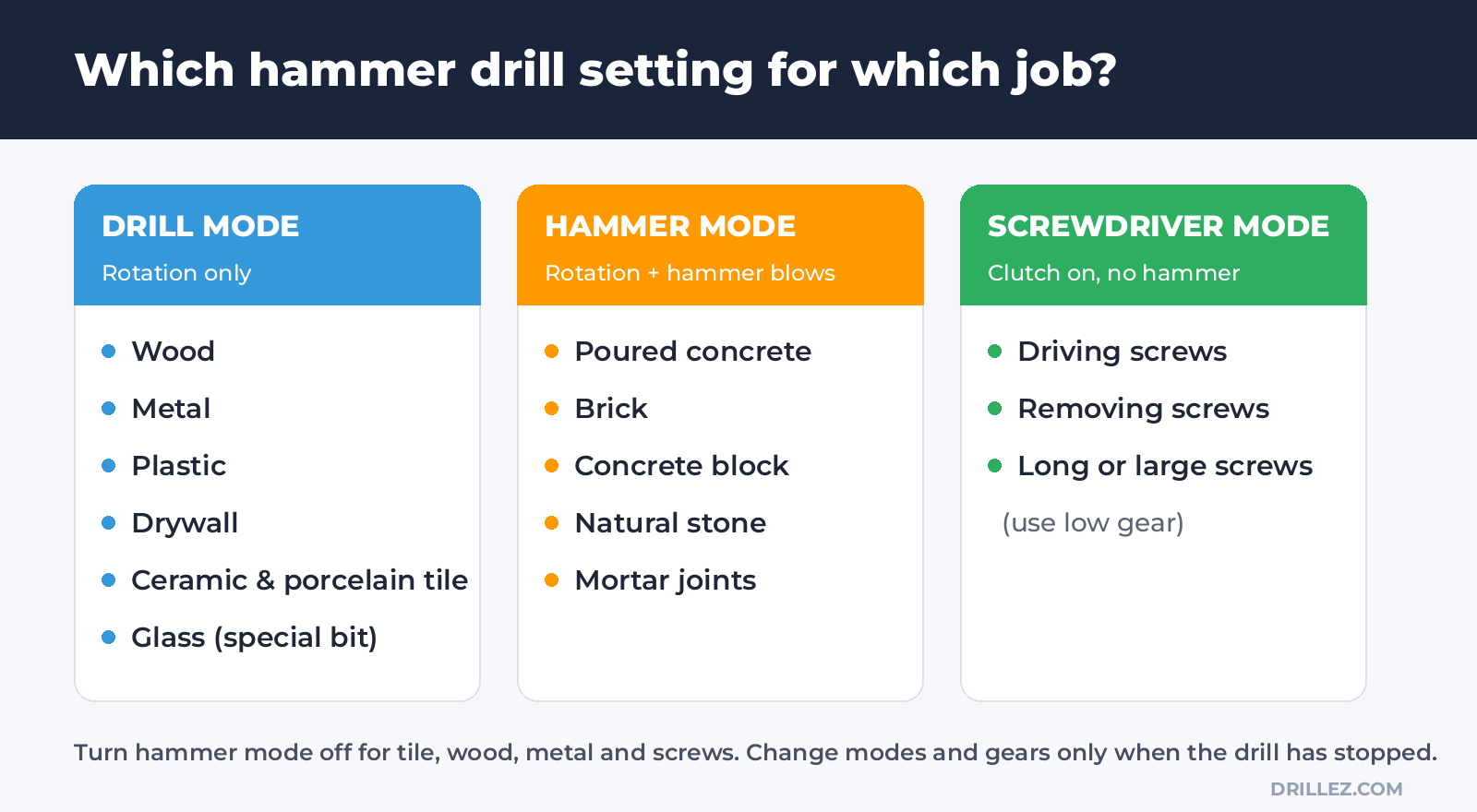
You need hammer mode for poured concrete, brick, concrete block, stone and mortar, for example when hanging shelves on a brick wall, fixing a TV bracket to concrete, mounting a mailbox post or anchoring a bottom plate to a slab. For wood, metal, plastic, drywall and tile, hammer mode should be off. If you are still choosing between tools, our guide to hammer drill vs impact driver explains which tool does what. For anchor choice and hole sizes in concrete, see our guide on how to drill into a concrete wall.
One limit is worth knowing early. A hammer drill is built for small and medium holes. DEWALT, for example, lists a maximum masonry capacity of 1/2 in (13 mm) with carbide bits for its 20V MAX DCD996 hammerdrill. For bigger holes, dozens of holes, or very hard concrete, a rotary hammer (SDS tool) hits much harder and is the better choice. If you are shopping, our roundup of the best hammer drills for concrete compares both types.
What You Need
| Item | Why it matters |
|---|---|
| Hammer drill (corded or cordless) | Must have a hammer setting; check that the battery is charged before you start |
| Carbide-tipped masonry bit | Ordinary twist bits will not last; the bit should be rated for percussion drilling |
| Side (auxiliary) handle | Lets you control the twist if the bit binds; most hammer drills include one |
| Depth rod or tape | Stops you drilling too deep or breaking through the back of a wall |
| Safety glasses and hearing protection | Masonry chips fly, and hammer mode is loud |
| Dust control | A vacuum with a HEPA filter, or a dust shroud, plus a suitable respirator for dusty work |
| Detector | A stud, pipe and wire scanner helps you avoid hidden services |
| Pencil, masking tape, anchors | For marking, preventing chipping and fixing whatever you are mounting |
Know the Controls on Your Hammer Drill
Layouts differ between brands, but most cordless and corded hammer drills share the same parts. A minute spent finding them on your own tool saves a lot of guesswork.
- Mode collar or selector. Usually has a drill symbol, a hammer symbol and numbered clutch settings for screwdriving. In the drill and hammer positions the clutch is off, so the drill will not slip if the bit jams. That is why a firm grip matters.
- Speed (gear) selector. Most cordless models have two or three gears. Low gear gives more torque; high gear gives more speed. Change gear only when the motor has fully stopped.
- Variable-speed trigger. Light pressure means slow; full pressure means full speed. Starting slowly keeps the bit from wandering.
- Forward/reverse switch. Set it to forward for drilling. In the middle position it usually locks the trigger, which is handy when changing bits.
- Side handle. Clamps around the front of the drill and rotates so you can hold it on either side. Tighten it firmly so it cannot spin if the bit catches.
- Depth rod. A metal rod that slides through the side handle. Set it so it touches the wall when the hole is deep enough.
- Keyless chuck. Holds round and hex-shank bits. Hammer drills do not take SDS bits; those need a rotary hammer.
The hammer rate on a hammer drill rises with motor speed. In its manual, DEWALT lists its 20V MAX DCD998 hammerdrill at up to 8,500 blows per minute in first gear and up to 38,250 in third. That is one reason why small masonry holes usually go faster in the higher gear, while large bits and starting a hole work better at lower speed.
Choose the Right Bit
For hammer drilling, use a carbide-tipped masonry bit that is rated for percussion. The hard tungsten-carbide tip survives the hammering; the flutes are shaped to carry dust out. Look for a hex or round shank that fits your chuck. Our guide to types of drill bits covers masonry, SDS, tile and diamond bits in more detail.
- Match the bit to the anchor. Wall plugs, sleeve anchors and concrete screws each state the bit diameter to use. Follow the packaging; a hole that is too big lets the anchor spin, and one that is too small makes it hard to drive. Our drill bit size chart helps you convert between fractional and metric sizes.
- Check the length. The bit needs enough working length for the depth of the hole plus some room for dust to clear.
- Replace dull bits. A worn carbide tip looks rounded and drills slowly. Pushing harder only creates heat; a new bit is cheaper than a burnt-out motor.
- Tile and glass need different bits. Use a tile, glass or diamond bit in drill mode. Masonry bits with hammering can crack the glaze.
Safety First: Before You Drill
- Check what is behind the surface. Scan the area with a detector before drilling, especially near switches, sockets, radiators and plumbing fixtures. If you are not sure what is behind the surface, move the hole.
- Protect your eyes and ears. Wear safety glasses. DEWALT’s manuals tell users to wear ear protectors when impact drilling, because the noise from hammer mode adds up quickly.
- Control the dust. Concrete, brick, block and stone contain crystalline silica. Breathing the fine dust over time can cause serious lung disease. Use a dust shroud connected to a vacuum, or a vacuum held at the hole, and choose a vacuum with a HEPA filter. For dusty or long jobs, wear a properly fitted respirator, and never dry sweep the mess; vacuum it.
- Use the side handle. Hold the drill with both hands. If the bit jams, the drill body tries to twist, and the side handle gives you leverage to stop it.
- Get stable. Stand with your feet about shoulder-width apart and your weight balanced. On a ladder, do not overreach; move the ladder instead. For overhead holes, a work platform is safer than a ladder.
- Remove the battery before changing bits. Or unplug a corded drill. It only takes one accidental trigger pull.
How to Use a Hammer Drill: Step by Step
1. Mark the hole
Measure and mark the center of the hole with a pencil. On smooth or painted surfaces, a small piece of masking tape over the mark helps stop the bit skating and reduces chipping around the edge.
2. Fit the bit
Remove the battery, open the chuck and insert the bit. DEWALT recommends inserting it about 3/4 in (19 mm) into the chuck, then tightening the sleeve firmly by hand until it ratchets. Never tighten a chuck by holding it and pulling the trigger. If your drill is new to you, our guide on how to change a drill bit walks through every chuck type.
3. Set the depth
Check the anchor or screw instructions for the hole depth, then set the depth rod to match. A hole slightly deeper than the fixing leaves room for dust that you cannot get out. If there is no depth rod, wrap a flag of tape around the bit at the right depth.
4. Select hammer mode and speed
With the drill stopped, turn the mode collar to the hammer symbol and set the forward direction. For small masonry bits, the higher gear usually drills faster; for larger bits, use a lower gear. Fit the battery, or plug in, only when everything is set.
5. Get a firm grip
Hold the main handle in one hand and the side handle in the other. Keep your wrists straight and the drill square to the wall, both horizontally and vertically. A small bubble level on the wall or a helper watching from the side can help on the first few holes.
6. Start slowly
Put the bit tip on the mark and squeeze the trigger gently. Let the bit cut a shallow dimple before you go to full speed. If it wanders, stop, re-mark and start again. On glazed or very hard surfaces, some people start the first few millimeters in drill mode, then switch to hammer once the bit is seated.
7. Drill with steady, moderate pressure
Once the bit is seated, increase the speed and push straight in. The manufacturer guidance is clear: apply just enough force to keep the hammer from bouncing or lifting off the bit. Leaning your full weight on the drill does not make it faster. It slows the hammer action and overheats the tool. Avoid side pressure too, because it clogs the flutes and can bend or break the bit.
8. Clear the dust
Every few centimeters on deep holes, pull the bit partly out while the motor is still running, then push it back in. This lets the flutes throw the dust out. Keeping the motor running while you withdraw it also stops the bit from jamming.
9. If the drill stalls, stop
If the bit jams, release the trigger immediately. Remove the bit and find the cause before you continue. DEWALT warns against cycling the trigger on and off to free a stalled drill, as this can damage it. Hitting steel reinforcing bar (rebar) is a common cause in concrete; a masonry bit will not cut it. The usual fix is to move the hole slightly.
10. Clean the hole and fit the anchor
Remove the dust from the hole with a vacuum nozzle or a hand blow-out bulb, then fit the anchor or screw. Dust left in the hole is the main reason anchors do not hold properly. Wipe the surface, vacuum the work area and check the bit for heat before you change it.
How to Drill Different Masonry Materials
| Material | Setting | Tips |
|---|---|---|
| Poured concrete | Hammer mode | Hardest common material. Use a sharp bit, clear dust often and expect to hit rebar or hard stones occasionally. |
| Brick | Hammer mode | Drilling into the brick face usually gives a firmer hold; mortar joints drill easily and are easier to patch later. For heavy loads, follow the anchor maker’s advice. |
| Concrete block | Hammer mode, light pressure | Blocks are hollow. Ease off as the bit breaks through into the hollow core so the back face does not blow out. Use anchors made for hollow block. |
| Natural stone | Hammer mode | Start very slowly to stop the bit skating. Soft stone can chip, so tape the surface. |
| Ceramic and porcelain tile | Drill mode only | Use a tile or diamond bit at low speed. Hammering can crack the tile. Switch to hammer mode only after you are through the tile and into masonry behind it. |
| Wood, metal, plastic, drywall | Drill mode | Hammer mode adds nothing here and can split wood or damage the hole. |
When to Turn Hammer Mode Off
Use hammer mode only while the bit is actually in masonry. Switch back to drill mode, with the drill stopped, when you:
- Drill through tile, glass or the glazed face of a surface
- Drill into wood, metal, plastic or drywall
- Drive or remove screws (use the clutch settings instead)
- Use a hole saw, spade bit or twist bit that is not rated for percussion
Common Hammer Drill Mistakes
- Pushing too hard. Excess force slows the hammer and heats the bit and motor. Moderate, steady pressure works better.
- Using the wrong bit. A twist bit or a worn masonry bit will smoke and barely progress.
- Forgetting hammer mode. If a masonry hole is barely moving, check that the collar is actually set to the hammer symbol.
- Drilling at an angle. An angled hole makes the anchor sit badly and can snap small bits.
- Skipping the side handle. Without it, a jammed bit can twist your wrist.
- Ignoring the dust. Dust in the hole weakens the fixing; dust in the air is a health risk.
- Changing gear while running. Wait for the drill to stop first, or you risk damaging the gearbox.
- Using hammer mode on tile. It is the quickest way to crack a tile you cannot easily replace.
Hammer Drill vs Rotary Hammer: When to Upgrade
A hammer drill is the right tool for occasional holes up to about 1/2 in in brick, block and concrete: shelf brackets, curtain rails, TV mounts and small anchors. If you need many holes, larger diameters or deep holes in hard concrete, a rotary hammer is a better choice. It uses a piston to deliver heavier blows, takes SDS-plus or SDS-max bits, and often has a chisel mode for removing tile or breaking small sections of concrete.
Care and Maintenance
- Let the bit cool in the air after hard drilling; carbide bits get very hot.
- Blow or brush dust out of the motor vents regularly, with the battery removed.
- Wipe the chuck jaws clean so bits grip properly.
- Store bits in a case so the carbide tips do not chip against each other.
- Charge batteries after use; a weak battery makes hammer mode feel slow.
Frequently Asked Questions
Can I use a hammer drill as a regular drill?
Yes. Turn hammer mode off and it works as a normal drill/driver for wood, metal and screws. Many people buy a hammer drill as their only drill for this reason.
Why won’t my hammer drill go into concrete?
Check five things: that hammer mode is on, that you are using a sharp carbide masonry bit, that the battery is charged, that you are not pushing so hard the hammer action stalls, and that you have not hit rebar or a hard stone. If all of these are fine and the concrete is very hard, a rotary hammer may be needed.
Do I need hammer mode for drywall?
No. Drywall is soft; drill mode is enough. Only switch to hammer if there is masonry behind it and you have reached it.
Can I drill into tile with a hammer drill?
Yes, but with hammer mode off. Use a tile or diamond bit, low speed and light pressure. Once you are through the tile into the masonry behind, stop, switch to a masonry bit and turn hammer mode on.
How deep should I drill for an anchor?
Follow the depth on the anchor packaging. Most people drill a little deeper than the anchor length so leftover dust does not stop it seating fully.
Can I use hammer mode to drive screws?
No. Hammer mode is for drilling masonry only. Use the numbered clutch settings for screws so the clutch slips before you strip the head or the hole.
Is a cordless hammer drill powerful enough?
For typical household jobs in brick, block and concrete with bits up to about 1/2 in, a good cordless hammer drill works well. For frequent or large-diameter holes, a corded hammer drill or a rotary hammer is a better fit.
Summary
To use a hammer drill well: fit a carbide masonry bit, set the depth, switch to hammer mode with the drill stopped, and hold it square with both hands. Start slowly, then use steady, moderate pressure and clear the dust as you go. Turn hammer mode off for tile, wood, metal and screws. Protect your eyes, ears and lungs, and you will get clean, accurate holes that hold anchors properly.