How to Drill Into a Concrete Wall: Bits, Anchors & Step-by-Step Guide
Drilling into a concrete wall is one of those jobs that looks hard but is simple once you have the right tool, the right bit and the right anchor. Most failures come from three things: using an ordinary drill bit, guessing the hole size, or choosing an anchor that does not suit the wall. This guide fixes all three, step by step.
Quick answer: check the wall for cables, pipes and rebar, then mark the hole. Fit a carbide-tipped masonry bit in the size your anchor maker specifies, set a depth stop, and drill in hammer mode with steady, moderate pressure, pulling the bit out now and then to clear dust. Vacuum the hole clean, then install the anchor exactly as its instructions say.
First, Check What Your Wall Is Made Of
“Concrete wall” can mean several different things, and each behaves differently when you drill it. A quick test hole with a small masonry bit usually tells you.
| What you find | Signs | What it means |
|---|---|---|
| Poured (solid) concrete | Very hard, slow drilling, gray dust, steady resistance all the way | Strongest base. Suits concrete screws, sleeve anchors and wedge anchors. |
| Concrete block (CMU) | Hard for 1 to 1-1/2 in, then the bit suddenly breaks through into a hollow | Use anchors rated for hollow block, or drill into a grout-filled cell. Do not use wedge anchors in hollow cells. |
| Brick | Red or orange dust; mortar joints drill much more easily | Use masonry anchors suited to brick; follow the anchor maker’s advice on brick face vs mortar joint. |
| Plaster or render over masonry | Soft white or pale dust for the first few millimeters, then hard | Drill through the plaster first and make sure the anchor reaches the solid material behind it. |
| Drywall on furring strips | Soft, easy drilling, then a gap, then concrete | Use longer fixings that reach the concrete, or fix into the strips for light items. |
What You Need
- A hammer drill. It is the right tool for most concrete wall holes up to about 1/2 in. For bigger holes or lots of them, a rotary hammer (SDS) is faster and easier. A regular drill can manage a few small holes in soft masonry, but in poured concrete it is very slow and wears bits out quickly. Our list of the best hammer drills for concrete can help you choose one.
- Carbide-tipped masonry bits in the exact size your anchor needs. Our guide to types of drill bits explains masonry and SDS bits, and the drill bit size chart helps if your anchor lists a metric size.
- The right anchors for your wall and load (see the table below).
- A detector that finds metal and live wires.
- Safety gear: safety glasses, hearing protection and a properly fitted respirator.
- Dust control: a vacuum with a HEPA filter, held at the hole or connected to a dust shroud.
- A depth stop (the rod on your drill’s side handle) or tape on the bit, a pencil, masking tape and a level.
Choose the Anchor Before You Drill
The anchor decides the bit size and the hole depth, so pick it first. Always read the instructions on the packet; the details below are typical examples, not a substitute for your anchor’s own specification.
| Anchor type | Good for | Notes |
|---|---|---|
| Plastic wall plugs | Light items: pictures, small shelves, hooks | Cheap and easy. Match the plug to the screw size and use the bit size printed on the pack. |
| Concrete screws (for example Tapcon) | Light to medium loads; brackets, battens, conduit clips | No separate plug. Need a precise hole: Tapcon specifies a 5/32 in bit for 3/16 in screws and a 3/16 in bit for 1/4 in screws. |
| Sleeve anchors | Medium loads in concrete, block or brick | Expands along its length; versatile across masonry types. |
| Wedge anchors | Heavy loads in solid concrete | Hole is the same diameter as the anchor. Simpson Strong-Tie lists its Wedge-All for solid concrete or grout-filled masonry, not hollow block or brick. |
| Hollow-wall or block anchors | Hollow concrete block | Designed to grip the thin face shell of hollow block. |
If you are hanging something heavy or safety-critical, such as a wall-mounted TV, handrail, cabinet or anything over a bed or walkway, choose an anchor with a published load rating and follow its installation instructions exactly.
Safety: Rebar, Cables, Pipes and Dust
- Scan before you drill. Use a detector to check for electrical cables, water pipes and steel reinforcing bar (rebar). If you are not sure what is behind the surface, move the hole.
- Respect structural walls and slabs. Avoid drilling large or repeated holes through structural members without professional advice. Some floors and slabs are post-tensioned with steel tendons under high tension; never drill into them without checking with the building owner or an engineer. If you rent, check with your landlord before drilling.
- Control silica dust. Concrete dust contains crystalline silica, which can cause serious lung disease. Use a dust shroud or hold a HEPA vacuum at the hole, wear a respirator, and clean up with a vacuum rather than dry sweeping.
- Protect eyes and ears. Concrete chips fly, and hammer mode is loud.
- Hold on firmly. Use the side handle and both hands. If the bit jams, the drill body will try to twist.
How to Drill Into a Concrete Wall: Step by Step
1. Mark the spot
Measure, level and mark the hole with a pencil. On painted or smooth concrete, put a small piece of masking tape over the mark. It helps the bit stay put and reduces chipping around the edge.
2. Check the hole size and depth
Read the anchor instructions for the bit diameter and the hole depth. For example, Tapcon tells you to drill the hole at least 1/4 in deeper than the screw will be embedded, so dust that you cannot remove has somewhere to go. Set the depth rod on your drill, or wrap tape around the bit, at that depth.
3. Fit the masonry bit
Remove the battery, fit the bit and tighten the chuck firmly. If you are unsure how, see our guide on how to change a drill bit.
4. Set the drill to hammer mode
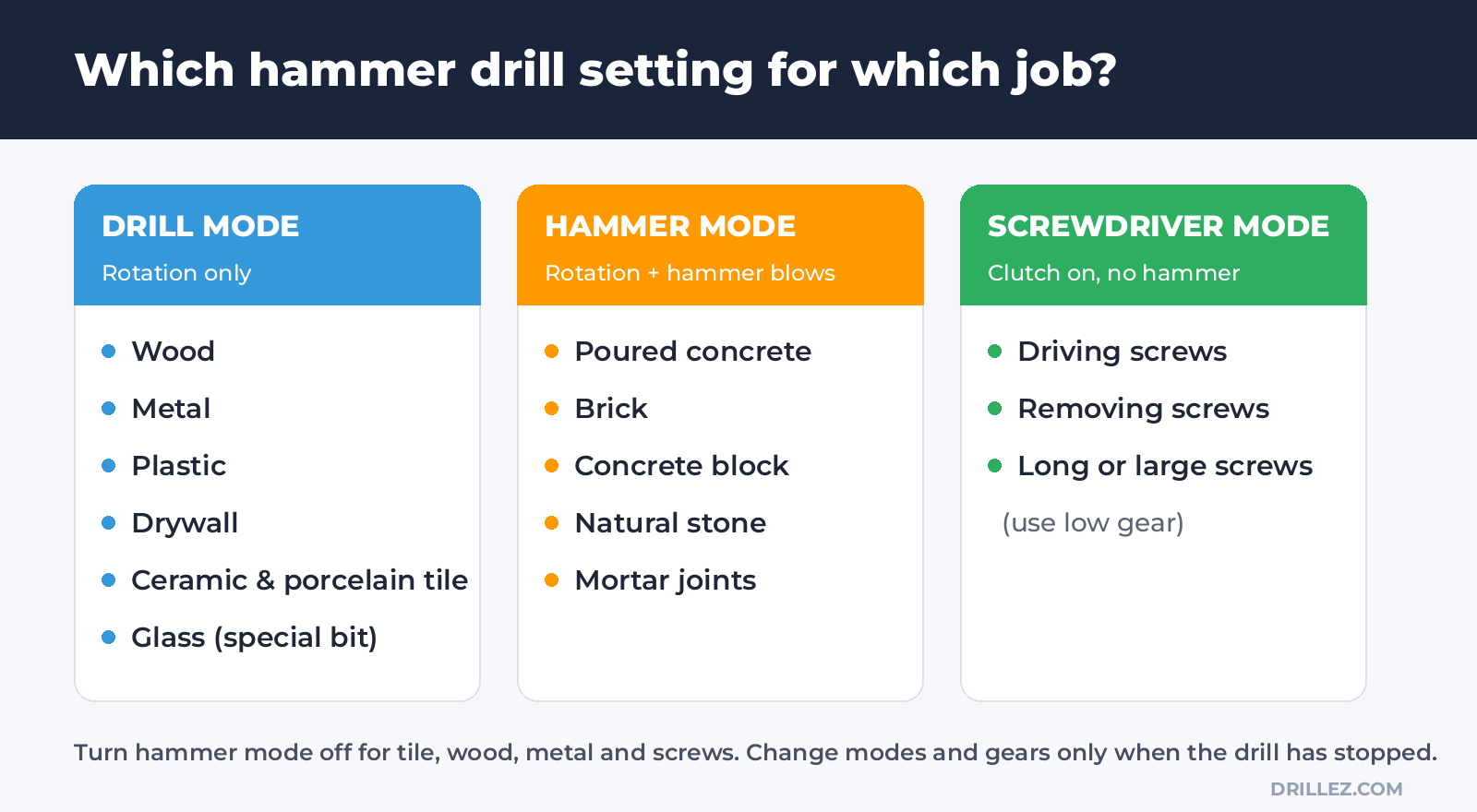
With the drill stopped, turn the mode selector to the hammer symbol and set the direction to forward. Our guide on how to use a hammer drill explains the controls and speed settings in more detail.
5. Start slowly and straight
Hold the drill square to the wall with both hands. Squeeze the trigger gently until the tip cuts a shallow dimple, then increase speed. If the bit wanders, stop, re-mark and start again.
6. Drill with steady pressure
Push straight in with moderate force. Let the hammer action do the work; leaning hard on the drill slows the blows and overheats the bit. Keep the drill level so the hole does not widen into an oval, which weakens the anchor’s grip.
7. Clear the dust as you go
Every so often, pull the bit partly out of the hole while the motor is still running, then continue. This clears the flutes and keeps the bit cutting.
8. Clean the hole
When you reach depth, remove the dust from the hole with a vacuum nozzle or a hand blow-out bulb, as anchor makers like Tapcon and Simpson Strong-Tie instruct. Dust left in the hole is a common reason anchors spin or pull out.
9. Install the anchor
Follow the anchor instructions exactly. Do not over-tighten: concrete screws can strip their threads in the hole, and expansion anchors have specific tightening torques. Simpson Strong-Tie, for example, says not to set or tighten its Wedge-All anchors with an impact wrench. Tapcon also advises against reusing its Tapcon+ screws for a new attachment because the threads wear.
Larger Holes and Deep Holes
Above about 1/2 in, a hammer drill starts to struggle in poured concrete. You have three options:
- Step up in sizes. Drill a smaller hole first, then enlarge it with the final bit. This reduces the load on the drill and helps keep the hole on target.
- Use a rotary hammer. It delivers much heavier blows with SDS-plus or SDS-max bits and makes large holes far easier.
- Use a diamond core bit for very large openings, such as for pipes or vents. Core drilling is usually done with a dedicated core drill and often with water to control dust.
Troubleshooting
| Problem | Likely cause | What to do |
|---|---|---|
| Hole barely gets deeper | Hammer mode off, dull bit, low battery or a very hard aggregate stone | Check the mode, fit a sharp bit, charge the battery. If you hit a hard stone, keep steady pressure; it usually breaks through. |
| Bit stops dead and you see metal shavings | You have hit rebar | Stop. A masonry bit will not cut steel. Move the hole slightly, and seek advice before cutting rebar in a structural wall. |
| Bit suddenly drops in | You broke into a hollow cell of a concrete block | Use an anchor designed for hollow block, or move to a solid area. |
| Hole is too big or oval | Drill wobbled or the bit was the wrong size | Move over and drill a new hole, or use a larger anchor that suits the new size. |
| Anchor spins in the hole | Hole oversized or full of dust | Clean the hole; if it is still loose, re-drill nearby. |
| Concrete chips around the hole | Started too fast or drilled through a smooth surface without tape | Start slowly; use masking tape; a small chip is usually hidden by the fixture. |
Common Mistakes to Avoid
- Using a twist bit or wood bit on concrete
- Guessing the hole size instead of reading the anchor instructions
- Using wedge anchors in hollow block or brick
- Drilling without scanning for cables and pipes
- Skipping dust control indoors
- Over-tightening concrete screws until they strip
- Drilling too close to the edge of a wall or corner, which can crack the concrete; check the anchor’s minimum edge distance
Frequently Asked Questions
Can I drill into a concrete wall with a regular drill?
For one or two small holes in softer masonry, a regular drill with a sharp masonry bit can work, slowly. In poured concrete it is hard going and wears bits out fast. A hammer drill is the better tool; see our comparison of a hammer drill vs an impact driver if you are deciding what to buy.
What size drill bit should I use for concrete screws?
Use the size your screw maker specifies. Tapcon, for example, specifies a 5/32 in bit for 3/16 in screws and a 3/16 in bit for 1/4 in screws. Using a bit that is too large reduces the holding power.
How deep should I drill?
Drill a little deeper than the anchor’s embedment depth, as stated in its instructions. Tapcon recommends at least 1/4 in deeper than embedment.
Do I need a pilot hole?
For small anchors, no. For larger holes, drilling a smaller hole first and then enlarging it can make the job easier on the drill.
Should I use water when drilling concrete?
Water is normally used with diamond core bits, not with standard carbide masonry bits in a hammer drill. For hammer drilling, rely on a vacuum or dust shroud instead.
What if I hit rebar?
Stop drilling. Move the hole a little to one side. Special rebar-cutting bits exist, but cutting reinforcement in a structural wall can affect its strength, so get advice first.
Can I drill into a concrete ceiling?
Yes, with the same method, but wear eye protection, use a dust shroud and work from a stable platform. Check the anchor is rated for overhead use.
Summary
Identify the wall material, choose the anchor, and use the bit size and depth that the anchor maker specifies. Scan for cables, pipes and rebar, then drill in hammer mode with steady pressure, clearing dust as you go. Clean the hole before fitting the anchor, and tighten it only as much as its instructions allow. Do that, and your fixings will hold securely for years.