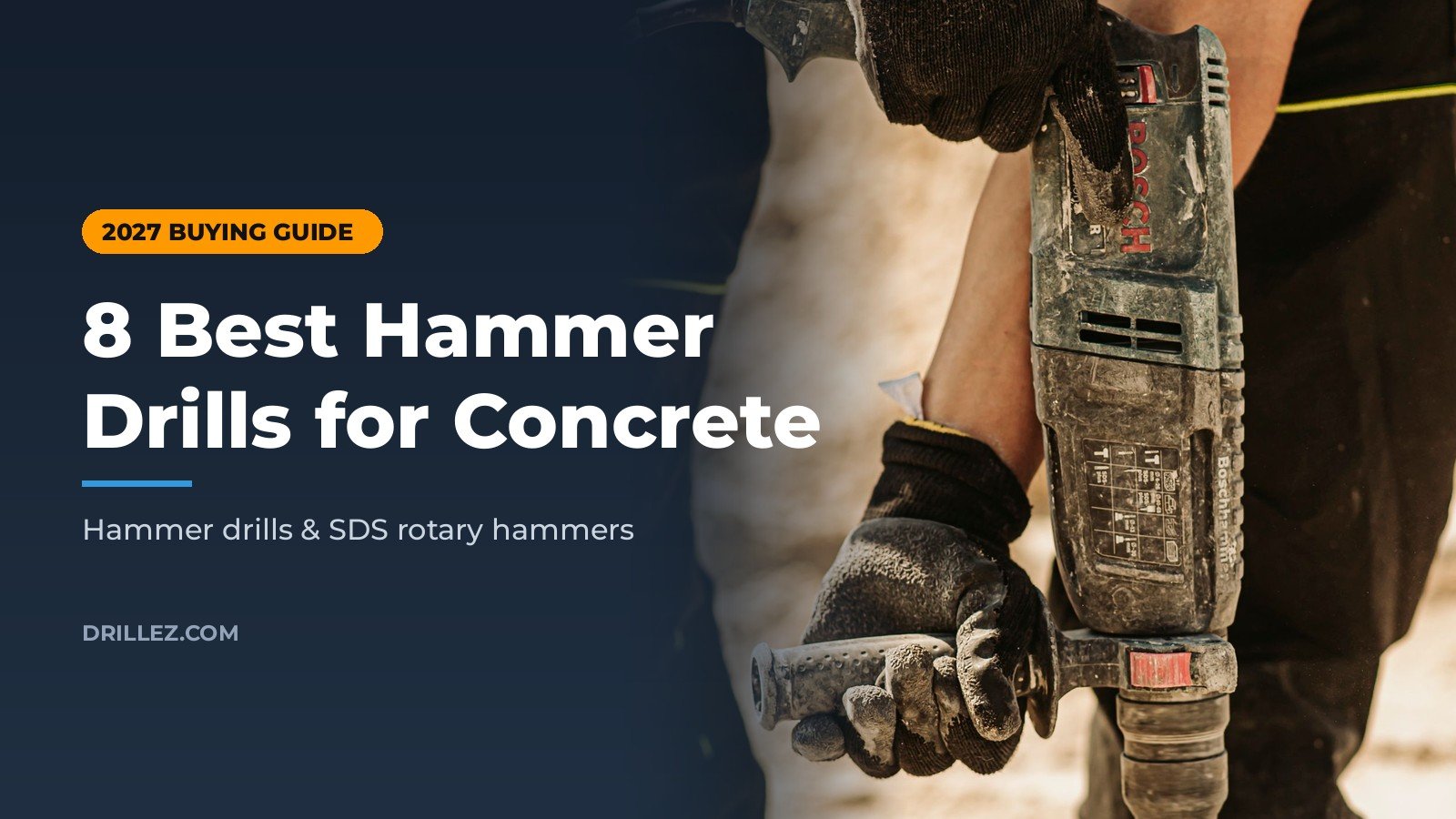
8 Best Hammer Drills for Concrete in 2027: Reviews & Buying Guide
Drillez is reader-supported. As an Amazon Associate, Drillez earns from qualifying purchases. Learn more.
Concrete is where an ordinary drill gives up. A regular drill only spins the bit, so it skates, overheats and barely scratches the surface. A hammer drill adds thousands of rapid forward blows per minute that chip the concrete while the bit turns, and a rotary hammer goes further with a piston-driven blow that breaks concrete far more efficiently. Choosing the right tool decides whether a job takes seconds or turns into a frustrating, smoky struggle.
In this guide we compare 8 tools for drilling concrete, brick and block that are currently available: cordless hammer drills for everyday anchors and fixings, corded hammer drills with unlimited runtime, budget options for occasional jobs, and SDS-plus rotary hammers for frequent or large holes. We also explain when you need a hammer drill versus a rotary hammer, how to read specs like BPM and joules, which bits to use, and how to drill concrete safely.
How we chose these tools: we have not hands-on tested these drills. We compared them using the specifications and features published by the manufacturers, checked that each model is currently available, reviewed what leading tool publications recommend, and matched each tool to the concrete-drilling job it suits best. Where a listing gives a number, we quote it; where it does not, we do not guess.
Quick Picks
- Best cordless hammer drill overall: Milwaukee M18 FUEL 1/2″ Hammer Drill/Driver
- Best DEWALT cordless: DEWALT 20V MAX XR DCD996B
- Best compact cordless: Makita XPH14Z 18V LXT
- Best corded hammer drill: DEWALT DWD520 10 Amp
- Best value corded: SKIL HD182001 7.5 Amp
- Best budget: BLACK+DECKER BEHD201 6.5 Amp
- Best corded rotary hammer: Bosch GBH2-28L Bulldog Xtreme Max
- Best cordless rotary hammer: DEWALT DCH273B 20V MAX SDS-plus
Key Takeaways
- A hammer drill is enough for occasional small holes in brick and concrete and doubles as a normal drill.
- A rotary hammer (SDS-plus) drills concrete much faster and is worth it for frequent or larger holes.
- Cordless tools are the most convenient; corded tools cost less and never run out of power.
- Use carbide masonry bits or SDS bits, a side handle and proper dust protection every time.
Comparison of the Best Hammer Drills for Concrete in 2027
| Tool | Type | Power source | Chuck | Key spec (listed) | Best for |
|---|---|---|---|---|---|
| Milwaukee M18 FUEL | Hammer drill | 18V cordless | 1/2″ metal, carbide teeth | 1,400 in-lbs torque | All-round cordless use |
| DEWALT DCD996B | Hammer drill | 20V cordless | 1/2″ ratcheting metal | 3-speed, brushless | DEWALT 20V users |
| Makita XPH14Z | Hammer drill | 18V cordless | 1/2″ metal, self-ratcheting | 0–31,500 BPM, 7″ long | Tight spaces |
| DEWALT DWD520 | Hammer drill | Corded, 10 A | 1/2″ | 2-speed, side handle | Unlimited runtime |
| SKIL HD182001 | Hammer drill | Corded, 7.5 A | 1/2″ keyed | Side handle, lock-on | Value corded |
| BLACK+DECKER BEHD201 | Hammer drill | Corded, 6.5 A | 1/2″ single-sleeve | 48,000 BPM | Occasional jobs |
| Bosch GBH2-28L | Rotary hammer | Corded, 8.5 A | SDS-plus | 2.4 ft-lbs impact energy | Frequent and large holes |
| DEWALT DCH273B | Rotary hammer | 20V cordless | SDS-plus | 2.1 J impact energy | Overhead anchors |
Hammer Drill vs Rotary Hammer vs Regular Drill
The most important decision is the type of tool. This table shows how they compare for concrete work.
| Regular drill | Hammer drill | Rotary hammer (SDS) | |
|---|---|---|---|
| How it drills concrete | Rotation only | Rotation plus fast, light blows from ridged clutch plates | Rotation plus heavy blows from a piston |
| Concrete performance | Poor | Good for small holes | Excellent, fastest |
| Typical hole size in concrete | Not recommended | Small anchors and plugs | Small to large holes |
| Chuck | 3-jaw | 3-jaw (usually 1/2″) | SDS-plus or SDS-max |
| Chiseling | No | No | Many models (with chisel mode) |
| Wood and metal drilling | Yes | Yes (hammer off) | Possible with an adapter, but not ideal |
| Best for | Wood, metal, plastic | Occasional to regular masonry plus general drilling | Frequent concrete drilling and demolition |
Rule of thumb: if you drill a handful of small holes in concrete or brick for anchors, shelves or TV mounts, a hammer drill is enough. If you drill concrete often, need larger holes or want to chip tile and mortar, a rotary hammer is worth it.
What Is a Hammer Drill and How Does It Work?
A hammer drill looks like a regular drill, but inside it has two ridged discs, often called clutch plates or cams. When you switch to hammer mode, these discs ride over each other as the chuck turns, pushing the chuck forward and back very quickly. Each tiny forward movement is a “blow” that cracks the concrete in front of the bit, while the rotating flutes carry the dust out of the hole.
Because the blows come from the discs and from the pressure you apply, a hammer drill works best with firm, steady pressure. A rotary hammer works differently: an electric motor drives a piston that throws a striker against the back of the bit, producing a much stronger blow with less effort from you. That is why rotary hammers drill concrete so much faster and why they use special SDS bits that can slide back and forth in the chuck.
Most hammer drills also have a normal drill mode, and many cordless models add a clutch for driving screws, which makes them a versatile one-tool solution for homeowners.
8 Best Hammer Drills for Concrete: Detailed Reviews
1. Milwaukee M18 FUEL 1/2″ Hammer Drill/Driver (Tool Only)
Best for: Professionals and serious DIYers who want one powerful cordless drill for concrete, wood and metal.
| Specification | Details |
|---|---|
| Type | Cordless hammer drill/driver |
| Platform | Milwaukee M18 (18V) |
| Chuck | 1/2″ all-metal with carbide teeth |
| Max torque (listed) | 1,400 in-lbs |
| Speeds | 2 |
| Extras | Mechanical clutch, all-metal belt clip |
| Battery | Not included (tool only) |
Leading tool reviewers consistently rank Milwaukee’s M18 FUEL hammer drill near the top, and the published specs explain why. Milwaukee lists up to 1,400 in-lbs of maximum torque, and the hammer drill mode is designed for fast drilling into brick, block and concrete.
The 1/2-inch all-metal chuck has carbide teeth for strong grip and bit retention — important when a masonry bit hits aggregate and the drill tries to twist. A mechanical clutch gives consistent results when driving a wide range of fasteners, so this is also an excellent everyday drill/driver.
This listing is for the bare tool. If you are not already on the M18 platform, budget for a battery and charger; Milwaukee says the tool delivers its best runtime with 5.0Ah batteries.
Key features
- 1,400 in-lbs listed maximum torque
- Hammer drill mode for brick, block and concrete
- All-metal 1/2″ chuck with carbide teeth
- Mechanical clutch for driving
- Part of Milwaukee’s M18 battery system
Pros
- Very high torque
- Excellent all-round drill/driver
- Durable metal chuck
- Huge M18 battery platform
Cons
- Tool only; batteries cost extra
- Heavier than compact models
- Hammer drill, not a rotary hammer, for heavy concrete work
Who should buy it: Tradespeople and DIYers who drill masonry regularly and want a premium cordless drill for everything else.
Who should skip it: You drill many large holes in concrete — a rotary hammer will be much faster.
2. DEWALT 20V MAX XR DCD996B Brushless 3-Speed Hammer Drill (Tool Only)
Best for: DEWALT 20V users who want a powerful, proven cordless hammer drill.
| Specification | Details |
|---|---|
| Type | Cordless hammer drill/driver |
| Platform | DEWALT 20V MAX |
| Motor | Brushless |
| Chuck | 1/2″ ratcheting, nitro-carburized metal with carbide inserts |
| Speeds | 3 |
| Light | 3-mode LED with spotlight mode |
| Included (listed) | 360° side handle, belt hook |
The DCD996 was one of the picks in the original version of this Drillez guide, and it remains one of the most popular cordless hammer drills, with thousands of reviews on Amazon. DEWALT says its brushless motor delivers up to 75% more runtime than 18V NiCad brushed motors.
Three speeds give you a low gear for big bits and driving, plus higher speeds for fast drilling. The 1/2-inch ratcheting chuck is nitro-carburized metal with carbide inserts for strong bit grip, and a 360-degree side handle is included for control when hammer drilling.
DEWALT also highlights a 3-mode LED that is up to 20 times brighter than the previous model, with a spotlight mode that stays on for 20 minutes — handy in basements and crawlspaces.
Key features
- Brushless motor for runtime and efficiency
- 3-speed transmission
- Metal ratcheting chuck with carbide inserts
- 3-mode LED with spotlight
- 360° side handle included
Pros
- Proven, popular model
- Three speeds for flexibility
- Side handle included
- Bright work light
Cons
- Tool only; batteries cost extra
- Fairly heavy with a large battery
Who should buy it: Anyone on the DEWALT 20V platform who wants a heavy-duty hammer drill.
Who should skip it: You want the most compact drill for tight spaces — see the Makita XPH14Z.
3. Makita XPH14Z 18V LXT Brushless 1/2″ Hammer Driver-Drill (Tool Only)
Best for: Compact, powerful hammer drilling in tight spaces.
| Specification | Details |
|---|---|
| Type | Cordless hammer driver-drill |
| Platform | Makita 18V LXT |
| Max torque (listed) | 1,250 in-lbs |
| Speed (listed) | 0–550 / 0–2,100 RPM |
| Blows per minute (listed) | 0–31,500 BPM |
| Length (listed) | 7″ |
| Weight (listed) | 4 lb tool; 6 lb with battery |
The Makita XPH14Z packs a lot of power into a short body. Makita lists 1,250 in-lbs of maximum torque and up to 31,500 blows per minute, yet the tool is only 7 inches long — 14% shorter than the previous model, according to Makita.
A two-speed transmission (0–550 and 0–2,100 RPM) covers slow, high-torque work and fast drilling, and the all-metal 1/2-inch self-ratcheting chuck is designed for improved bit grip and durability.
The compact size makes it ideal for drilling between joists, inside cabinets and overhead, where a longer drill is awkward to hold.
Key features
- 1,250 in-lbs listed torque
- 0–31,500 BPM hammer rate
- Only 7″ long
- 2-speed transmission
- Metal self-ratcheting chuck
Pros
- Very compact for its power
- Published BPM and torque figures
- Light at a listed 4 lb (tool)
- Large Makita LXT battery platform
Cons
- Tool only; batteries cost extra
- Slightly less torque than the Milwaukee
Who should buy it: Makita users and anyone who often drills in tight or overhead positions.
Who should skip it: You need maximum torque for large augers and hole saws.
4. DEWALT DWD520 10 Amp 1/2″ Pistol-Grip Hammer Drill
Best for: Unlimited runtime for long masonry jobs, with plenty of power for wood and steel too.
| Specification | Details |
|---|---|
| Type | Corded hammer drill |
| Motor | 10 Amp |
| Chuck | 1/2″ |
| Modes | Hammerdrill / drill |
| Speeds | 2 |
| Handle | 360° locking side handle with soft grip |
| Housing | Metal gear housing |
If you work near an outlet and drill a lot of masonry, a corded hammer drill never runs out of battery. The DWD520 uses a 10 Amp motor, and DEWALT states its motor design generates 50% more power with increased overload protection for added durability.
A dual-mode switch changes between hammer drilling for masonry and standard drilling for wood and steel, and a two-speed range lets you choose high speed for drilling or high torque for large bits.
The 360-degree locking side handle and metal gear housing make it a solid jobsite tool. Note that Amazon availability for this model can vary; check the listing before you buy. For more corded options, see our guide to the best corded hammer drills.
Key features
- 10 Amp motor with overload protection
- Dual mode: hammerdrill or drill
- 2-speed range
- 360° side handle
- Metal gear housing
Pros
- Unlimited runtime
- Powerful 10 Amp motor
- Two speeds
- Side handle for control
Cons
- Needs an outlet or extension cord
- Heavier than compact cordless drills
- Availability can vary
Who should buy it: Contractors and DIYers who drill masonry for long periods near power.
Who should skip it: You work on ladders or away from outlets — choose a cordless model.
5. SKIL HD182001 7.5 Amp 1/2″ Corded Hammer Drill
Best for: Good-value corded hammer drilling for regular DIY projects.
| Specification | Details |
|---|---|
| Type | Corded hammer drill |
| Motor | 7.5 Amp |
| Chuck | 1/2″ heavy-duty keyed |
| Modes | Drill / hammer drill |
| Handle | Side assist handle |
| Trigger | 2-finger variable speed with lock-on button |
The SKIL HD182001 is a sensible middle ground between budget and professional corded hammer drills. A 7.5 Amp motor handles anchors in concrete and brick, and a quick switch changes between drilling and hammer drilling.
A 1/2-inch heavy-duty keyed chuck holds larger bits securely, and the side assist handle improves safety and accuracy when the bit grabs. The two-finger variable-speed trigger, lock-on button and soft-grip handle make long drilling sessions more comfortable.
Key features
- 7.5 Amp motor
- 2-in-1: drill or hammer drill
- 1/2″ keyed chuck for large bits
- Side assist handle
- Lock-on button for extended drilling
Pros
- Good power for the price
- Side handle included
- Keyed chuck grips large bits
- Unlimited corded runtime
Cons
- Keyed chuck is slower for bit changes
- Not as powerful as 10 Amp models
Who should buy it: Homeowners and DIYers who drill into brick and concrete a few times a year or more.
Who should skip it: You drill concrete every day — consider a rotary hammer.
6. BLACK+DECKER BEHD201 6.5 Amp 1/2″ Hammer Drill
Best for: Occasional masonry jobs on a tight budget.
| Specification | Details |
|---|---|
| Type | Corded hammer drill |
| Motor | 6.5 Amp |
| Blows per minute (listed) | 48,000 BPM |
| Chuck | 1/2″ single-sleeve |
| Modes | 2-position switch: drill / hammer drill |
| Handle | 3-position side handle |
The BEHD201 is one of the most affordable ways to drill into concrete, brick and stone. BLACK+DECKER lists a 6.5 Amp motor delivering 48,000 blows per minute, which is enough for small anchor holes and wall plugs.
A two-position switch selects standard drilling for wood or hammer drilling for masonry, and the 1/2-inch single-sleeve chuck allows easy bit changes and larger bits. A three-position side handle helps reduce fatigue and keeps the drill under control.
It is not a tool for daily jobsite use, but for hanging shelves on brick, installing a TV mount on concrete or fitting curtain rails, it gets the job done for little money.
Key features
- 48,000 BPM listed hammer rate
- Drill / hammer switch
- 1/2″ single-sleeve chuck
- 3-position side handle
Pros
- Very affordable
- Easy bit changes
- Side handle included
- Thousands of owner reviews
Cons
- Least powerful tool in this guide
- Not for frequent or heavy concrete work
Who should buy it: Homeowners who need to drill a few holes in masonry now and then.
Who should skip it: You drill concrete regularly or need large holes.
7. Bosch GBH2-28L 8.5 Amp SDS-plus Bulldog Xtreme Max Rotary Hammer
Best for: Frequent concrete drilling, larger holes and light chiseling.
| Specification | Details |
|---|---|
| Type | Corded SDS-plus rotary hammer |
| Motor | 8.5 Amp |
| Impact energy (listed) | 2.4 ft-lbs |
| Capacity | 1-1/8″ (per product name) |
| Modes | Drill only, hammer drill, chisel |
| Safety | KickBack Control |
| Handle | D-handle |
When concrete work becomes regular, a rotary hammer is the right tool. Instead of clutch plates, it uses a piston to deliver a much heavier blow, measured as impact energy. Bosch lists 2.4 ft-lbs for the GBH2-28L, driven by an 8.5 Amp motor.
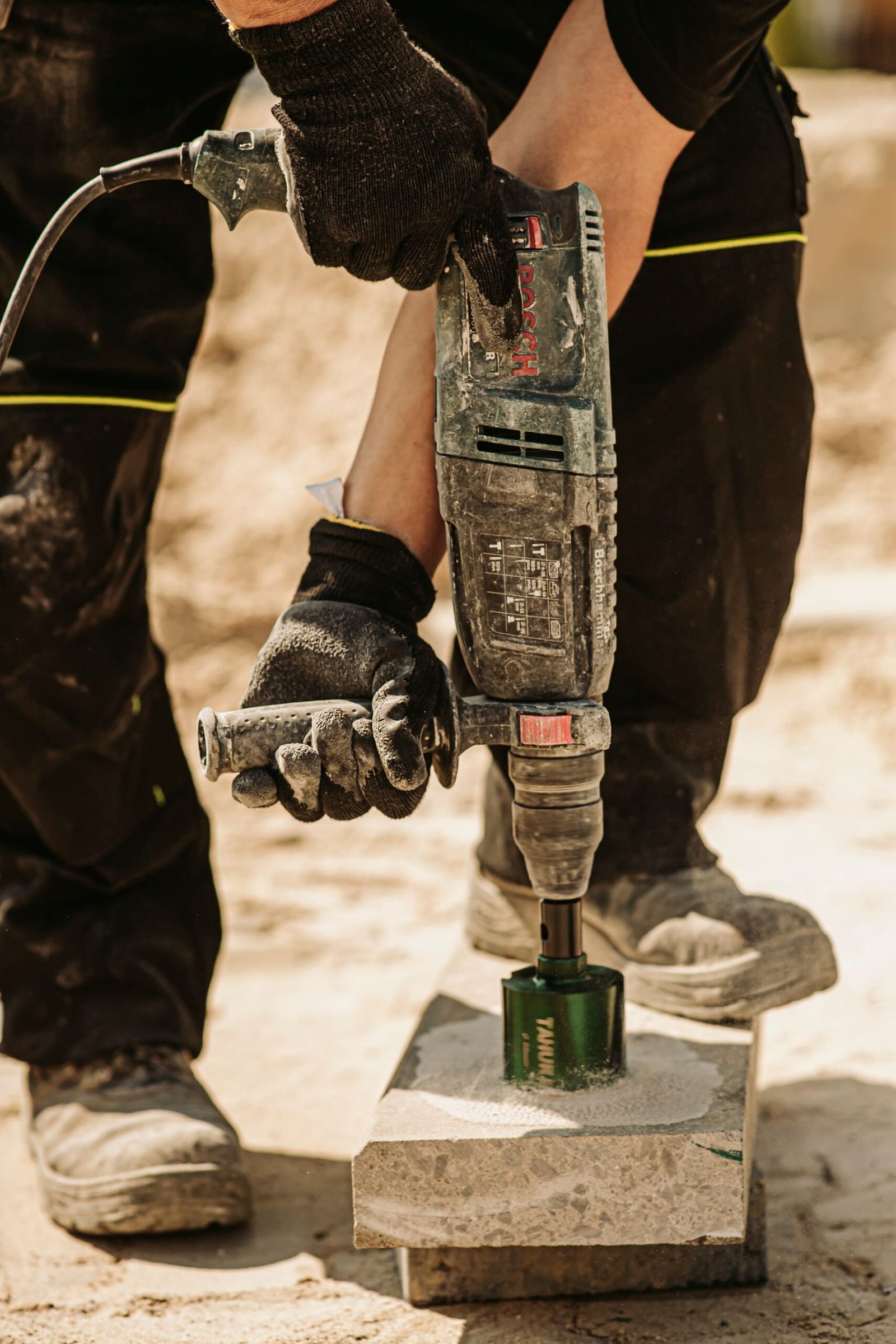
Bosch’s Bulldog line is a long-time favorite of reviewers. This model adds KickBack Control, which uses an integrated sensor to stop rotation if the bit binds — a valuable safety feature on a powerful tool. Counter-balanced vibration control improves comfort, and Vario-Lock rotates and locks the chisel at the best working angle.
Three modes — drilling only, hammer drilling and chiseling — let you drill anchor holes, bore larger holes and chip out tile or mortar with one tool. The D-handle is ideal for overhead and downward drilling.
Key features
- 2.4 ft-lbs listed impact energy
- KickBack Control sensor
- Vibration control
- 3 modes including chisel
- Vario-Lock chisel positioning
Pros
- Much faster than hammer drills in concrete
- KickBack Control safety
- Chisel mode for light demolition
- Unlimited corded runtime
Cons
- Needs SDS-plus bits
- Heavier than hammer drills
- Overkill for a few small holes
Who should buy it: Contractors, remodelers and DIYers who drill concrete often or need larger holes.
Who should skip it: You only drill a few small holes a year — a hammer drill is enough.
8. DEWALT DCH273B 20V MAX Brushless SDS-plus Rotary Hammer (Tool Only)
Best for: Cordless rotary hammer power for anchors, overhead work and jobsites without power.
| Specification | Details |
|---|---|
| Type | Cordless SDS-plus rotary hammer |
| Platform | DEWALT 20V MAX |
| Impact energy (listed) | 2.1 J |
| Motor | Brushless |
| Modes | 3 application modes |
| Vibration | SHOCKS Active Vibration Control |
| Dust (listed) | OSHA Table 1 compliant with DWH303DH extractor |
The DCH273B brings rotary-hammer performance to the DEWALT 20V platform. DEWALT lists 2.1 joules of impact energy for fast drilling in concrete, delivered by a brushless motor and a German-engineered mechanism.
DEWALT designed it to be lightweight for tasks such as rod hanging, seismic attachments, cable tray, strut and rail mounting — jobs that often mean drilling many holes overhead. The SHOCKS Active Vibration Control system reduces the vibration you feel at the handles.
For dust control, DEWALT states the tool is OSHA Table 1 compliant when paired with the DWH303DH on-board extractor, which matters on jobsites where silica dust rules apply. For more cordless rotary options, see our guide to the best cordless rotary hammer drills.
Key features
- 2.1 J listed impact energy
- Brushless motor
- 3 application modes
- SHOCKS vibration control
- OSHA Table 1 compliant with dust extractor
Pros
- Rotary hammer speed without a cord
- Light enough for overhead work
- Vibration control
- Dust extraction option
Cons
- Tool only; batteries cost extra
- Needs SDS-plus bits
- Less impact energy than the corded Bosch
Who should buy it: Electricians, mechanical contractors and DIYers on the DEWALT 20V platform who drill many anchor holes.
Who should skip it: You drill only a few holes — a cordless hammer drill is more versatile.
How to Choose the Best Hammer Drill for Concrete: Buying Guide
1. When is a hammer drill needed?
You need a hammer drill (or rotary hammer) whenever you drill into concrete, brick, block, stone or mortar — for example to fit wall anchors, mount a TV, install shelving, run cables through block walls or attach a ledger board to a foundation. For wood, metal and plastic, turn the hammer function off and use it as a normal drill.
2. Hammer drill or rotary hammer?
| Your situation | Best choice |
|---|---|
| A few small holes per year (wall plugs, TV mounts) | Budget or mid-range hammer drill |
| Regular DIY masonry plus general drilling and driving | Cordless hammer drill |
| Many anchor holes, larger holes, hard concrete | SDS-plus rotary hammer |
| Chipping tile, mortar or small demolition | Rotary hammer with chisel mode |
| Core holes and heavy demolition | SDS-max rotary hammer or demolition hammer |
3. Corded vs cordless
Cordless hammer drills are convenient, work anywhere and double as excellent drill/drivers, but you need batteries (often sold separately). Corded models cost less, never run out of power and suit long drilling sessions near an outlet. If you already own a battery platform, buying a bare tool from the same brand saves money. Read our full comparison: Corded vs Cordless Drill.
4. Power: amps, volts and torque
For corded tools, look at amperage: around 6–7 Amp for light work and 8–10 Amp for heavier use. For cordless tools, compare torque (in-lbs) and whether the motor is brushless, which generally improves efficiency and runtime. Learn more in how brushless drills work.
5. BPM and impact energy
BPM (blows per minute) tells you how often a hammer drill strikes. Higher BPM generally means faster drilling in masonry. Impact energy, given in joules (J) or foot-pounds (ft-lbs), is how hard each blow lands and is the key figure for rotary hammers. Compare like with like: hammer drills mostly list BPM, while rotary hammers list impact energy.
6. Chuck type
- 1/2-inch three-jaw chuck (hammer drills): accepts standard round- and hex-shank masonry bits as well as wood and metal bits.
- SDS-plus (most rotary hammers): bits slide and lock in with grooves on the shank, letting the bit hammer freely and transferring blows efficiently. Requires SDS-plus bits.
- SDS-max: a larger system for heavy rotary and demolition hammers.
7. Safety and comfort features
A side handle is essential when hammer drilling. Rotary hammers may add kickback control (which stops rotation if the bit binds) and active vibration control. A depth rod helps you drill every hole to the same depth for anchors.
8. Weight and size
Compact hammer drills are easier to use overhead and in tight spaces. Rotary hammers are heavier but do the work faster, so you push less. For frequent overhead drilling, choose a lighter cordless rotary hammer with vibration control.
How to Read Hammer Drill Specs
Tool boxes and listings are full of numbers. Here is what each one means for concrete work.
| Spec | What it means | Why it matters for concrete |
|---|---|---|
| RPM | How fast the chuck spins | Lower RPM under load is normal in masonry; very high RPM is more useful in wood |
| BPM | Blows per minute from the hammer mechanism | More blows usually means faster drilling in brick and concrete |
| Torque (in-lbs) | Twisting force (mainly cordless tools) | Helps with large bits and stops the drill stalling |
| Impact energy (J or ft-lbs) | Force of each blow (rotary hammers) | The key figure for drilling speed in concrete |
| Amps / volts | Motor power (corded) or battery voltage (cordless) | A rough guide to overall power |
| Chuck | 1/2″ three-jaw, SDS-plus or SDS-max | Decides which bits you can use |
Cordless Platforms: Should You Stay With One Brand?
Most cordless hammer drills are sold as bare tools, and the batteries are often the most expensive part of a cordless system. If you already own batteries from Milwaukee M18, DEWALT 20V MAX or Makita 18V LXT, buying a bare-tool hammer drill from the same brand is usually the best value. If you are starting fresh, choose the platform that offers the other tools you are likely to buy, such as an impact driver, circular saw or rotary hammer.
Battery size matters too. Larger batteries deliver longer runtime and often more sustained power under heavy load, while compact batteries keep the tool light for overhead work. Many users keep one of each.
Best Bits for Drilling Concrete
| Bit | Use with | Best for |
|---|---|---|
| Carbide-tipped masonry bit (round or hex shank) | Hammer drill | Small to medium anchor holes in brick, block and concrete |
| SDS-plus bit | SDS-plus rotary hammer | Fast holes in concrete; better bit retention |
| Rebar-cutting or four-cutter SDS bit | Rotary hammer | Concrete with aggregate or rebar contact |
| Core bit | Rotary hammer or core drill | Large holes for pipes and ducts |
| Chisel bits (point, flat, tile) | Rotary hammer with chisel mode | Removing tile, mortar and small concrete sections |
Do not use wood or standard metal bits in hammer mode; they are not designed for impact and will dull or break. For wood bits, see the best drill bits for wood.
Choosing the Right Concrete Anchor
The anchor decides the hole size and depth, so pick the anchor before you drill. Common types include:
- Plastic wall plugs: for light loads in brick and block.
- Concrete screws: thread directly into a pilot hole; they usually specify an exact bit diameter.
- Sleeve anchors: versatile medium-duty anchors for concrete, brick and block.
- Wedge anchors: heavy-duty anchors for solid concrete only.
- Hollow-wall anchors for block: designed for the hollow cores in concrete block.
Always use the bit size and embedment depth printed on the anchor packaging. A hole that is too large or too shallow will not hold.
How to Drill Into Concrete: Step by Step
- 1. Check for hazards. Use a detector to check for pipes, wires and rebar, especially in walls and floors.
- 2. Mark the hole. Mark the center and set the depth rod (or wrap tape on the bit) to the anchor depth plus a little extra for dust.
- 3. Fit the right bit. Use a sharp carbide-tipped masonry bit or SDS bit of the correct diameter for your anchor.
- 4. Start without hammer. Start slowly with the hammer function off to make a small locating dimple, so the bit does not wander.
- 5. Switch to hammer mode. Hold the drill square with both hands and let the tool do the work; heavy pushing does not speed it up.
- 6. Clear the dust. Pull the bit out occasionally to clear dust, then blow or vacuum the finished hole clean so the anchor holds properly.
- 7. Install the anchor. Insert the anchor or plug and fix your item.
For a full walkthrough, read how to drill into a concrete wall and how to use a hammer drill.
Drilling Concrete vs Brick vs Block
| Material | What to expect | Tips |
|---|---|---|
| Poured concrete | Hardest; may contain hard aggregate and rebar | Rotary hammer recommended for many holes; use sharp bits |
| Brick | Softer; can crack near edges | Drill into the brick, not the mortar joint, for strong anchors; avoid drilling too close to edges |
| Concrete block (CMU) | Hollow cores behind the face | Use anchors designed for hollow block; do not over-drill |
| Stone | Varies widely in hardness | Start slowly and keep the bit cool |
Safety: Concrete Dust and Other Risks
Drilling concrete, brick and stone creates fine dust that can contain crystalline silica, which is harmful to breathe. Protect yourself every time:
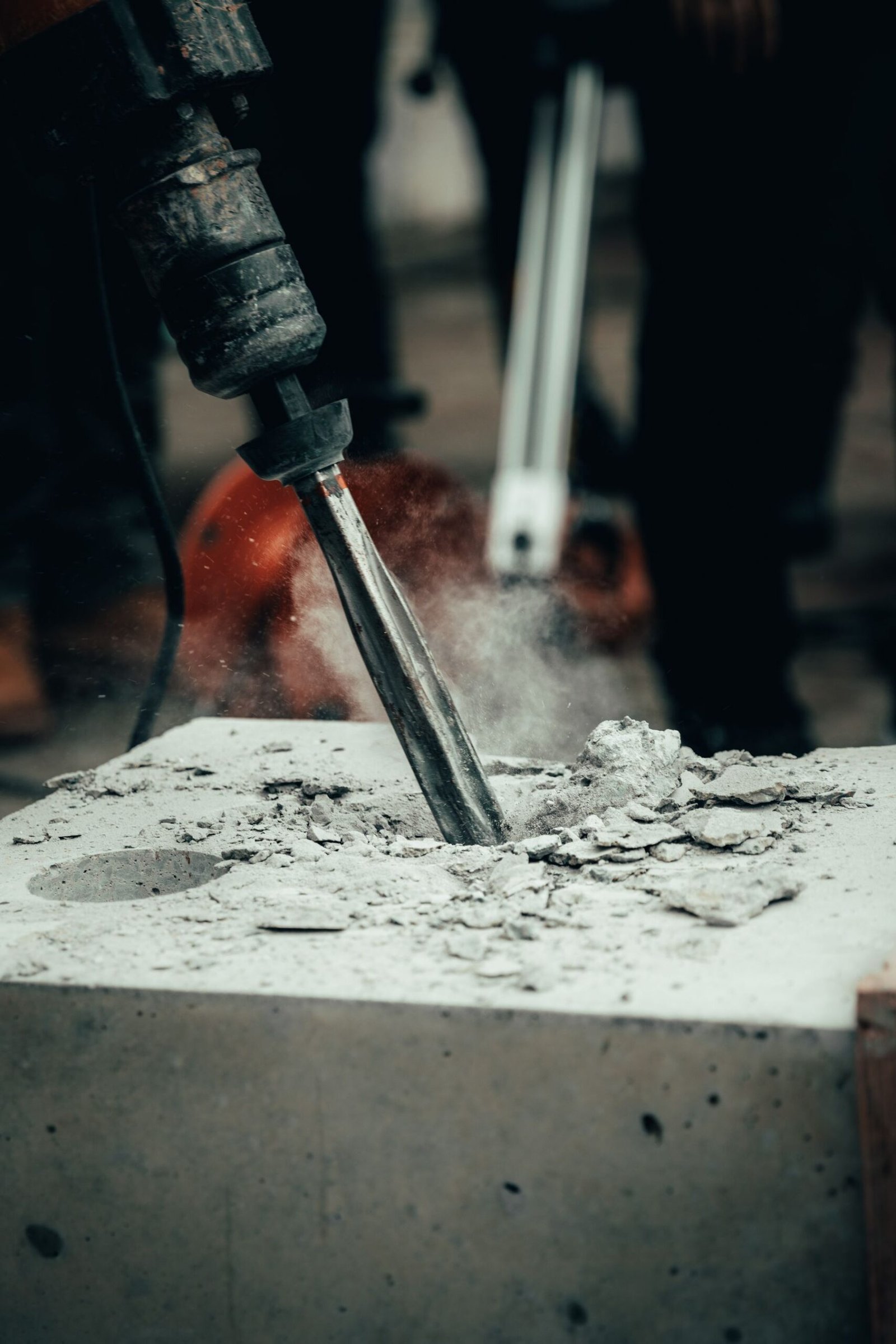
- Wear safety glasses or goggles, hearing protection and a properly fitted respirator rated for fine dust.
- Use dust extraction or a vacuum attachment where possible; on jobsites, follow local silica-dust rules (in the U.S., OSHA’s silica standard).
- Hold the drill with both hands and use the side handle; a binding bit can twist the tool sharply.
- Keep the cord away from the bit and check it for damage.
- Never drill where you suspect electrical cables or water pipes without checking first.
Common Concrete Drilling Projects and the Right Tool
| Project | Typical tool | Notes |
|---|---|---|
| Hanging shelves or pictures on brick | Hammer drill | Small masonry bit and wall plugs |
| Mounting a TV on a concrete wall | Hammer drill | Use anchors rated for the TV and mount weight |
| Fixing a ledger board or railing to a foundation | Rotary hammer or powerful hammer drill | Larger, deeper holes for structural anchors; follow the anchor maker’s specs |
| Running cables through block walls | Rotary hammer | Longer SDS bits reach through block |
| Installing many ceiling anchors | Cordless rotary hammer | Lightweight tool with vibration control reduces fatigue |
| Removing old floor tile | Rotary hammer with chisel mode | Use a wide tile chisel bit |
Common Mistakes to Avoid
- Using a regular drill on concrete. It is slow, overheats the bit and may damage the drill.
- Pushing too hard. Extra force reduces the hammering action. Firm, steady pressure is enough.
- Using worn bits. A dull masonry bit drills slowly and makes oversize holes. Replace it.
- Skipping the side handle. It is a safety feature, not an accessory.
- Leaving hammer mode on for wood or metal. It ruins holes and bits.
- Not cleaning the hole. Dust left in the hole weakens anchors.
- Buying a hammer drill for heavy daily concrete work. A rotary hammer is faster and easier on you.
How to Maintain Your Hammer Drill
- Blow dust out of the motor vents after masonry work.
- Clean and lightly grease SDS bit shanks as the manufacturer recommends.
- Inspect the cord, plug or battery contacts regularly.
- Store batteries at room temperature and charge them as directed.
- Replace worn carbon brushes on brushed corded models when needed (follow the manual).
Hammer Drill or Impact Driver?
An impact driver is not a substitute for a hammer drill on concrete. A hammer drill strikes forward along the bit to break up masonry; an impact driver strikes around the bit to drive screws and bolts. For a full comparison, read Hammer Drill vs Impact Driver.
Frequently Asked Questions (FAQ)
What is the best hammer drill for concrete?
For most people, a quality cordless hammer drill such as the Milwaukee M18 FUEL 1/2″ Hammer Drill/Driver is the best all-round choice. If you drill concrete often or need larger holes, an SDS-plus rotary hammer like the Bosch GBH2-28L will be much faster.
Can a regular drill go through concrete?
A regular drill can make a very small hole in soft masonry with a masonry bit, but it is slow and hard on the drill and bit. For concrete, use a hammer drill or rotary hammer.
Is a hammer drill or rotary hammer better for concrete?
A rotary hammer is better for concrete because its piston delivers much heavier blows. A hammer drill is more versatile for general drilling and is fine for occasional small holes.
What size hammer drill do I need for concrete?
For small anchors, a 1/2-inch hammer drill is enough. For frequent drilling or holes larger than about 1/2 inch in concrete, choose an SDS-plus rotary hammer.
Can I use a hammer drill on wood?
Yes. Switch the hammer function off and use it as a normal drill. Hammer mode in wood makes rough holes.
What drill bit do I use for concrete?
Use a carbide-tipped masonry bit in a hammer drill, or an SDS-plus bit in an SDS-plus rotary hammer.
Can I use an impact driver to drill concrete?
An impact driver is not designed for drilling concrete. Its blows are rotational rather than forward, so use a hammer drill or rotary hammer instead.
Are cordless hammer drills powerful enough for concrete?
Modern brushless cordless hammer drills handle anchor holes in concrete and brick well. For many large holes, a cordless or corded rotary hammer is better.
How deep should I drill for a concrete anchor?
Follow the anchor manufacturer’s instructions. Most recommend drilling slightly deeper than the anchor length so dust has somewhere to go.
Why is my hammer drill not drilling concrete?
Common causes are hammer mode not switched on, a dull or wrong bit, pushing too hard or too little, or hitting rebar or very hard aggregate. A rotary hammer handles hard concrete better.
What does BPM mean on a hammer drill?
BPM stands for blows per minute — how many times the hammer mechanism strikes each minute. Higher BPM generally means faster drilling in masonry.
Do I need a respirator when drilling concrete?
Yes. Concrete dust can contain crystalline silica, which is harmful to breathe. Use a properly rated respirator and dust extraction where possible.
How long does it take to drill a hole in concrete?
It depends on the hole size, the concrete and the tool. A rotary hammer drills concrete much faster than a hammer drill, and sharp bits make a big difference. If a hole is taking a long time, check that hammer mode is on and the bit is sharp.
Can I drill into concrete without hitting rebar?
A detector designed for concrete can help locate rebar before you drill. If you hit rebar unexpectedly, stop and move the hole if possible, or check with a structural professional before cutting reinforcement.
Can I use a hammer drill to drill through tile?
Not in hammer mode. Ceramic and porcelain tile can crack under hammer blows. Drill tile with the hammer function off, using a tile or diamond bit, then switch to hammer mode only once you reach the masonry behind it.
Are hammer drills loud?
Yes. Hammer drilling in masonry is loud, and rotary hammers are louder still. Always wear hearing protection, especially for longer jobs or when drilling indoors.
Do hammer drills work on stone and granite countertops?
Hammer mode can crack stone slabs and countertops. Use a diamond core bit with water cooling and the hammer function off for countertops.
Final Verdict
For most people who need to drill concrete, brick and block, the Milwaukee M18 FUEL Hammer Drill/Driver is the best all-round choice: it has a listed 1,400 in-lbs of torque, a durable metal chuck and works as an excellent everyday drill/driver. DEWALT users should choose the DCD996B, and Makita users who work in tight spaces will like the compact XPH14Z.
If you prefer corded power, the DEWALT DWD520 offers 10 Amps and two speeds, the SKIL HD182001 is great value, and the BLACK+DECKER BEHD201 covers occasional jobs for very little money. For frequent concrete drilling, step up to a rotary hammer: the corded Bosch GBH2-28L Bulldog Xtreme Max or the cordless DEWALT DCH273B.
Specifications are taken from the manufacturers’ product listings and were checked on November 26, 2026. Product details, prices and availability can change.
About This Guide
Drillez first published guides on drills, hammer drills and drilling accessories in 2018, and the site focuses on that one topic. For this guide we reviewed what leading tool publications recommend for concrete, compared current manufacturer specifications, checked that each tool is currently available, and stated clearly that our picks are based on published specs rather than hands-on testing. We update our guides when products or availability change.