
Drill Bit Size Chart: Fractional, Metric, Number & Letter Sizes
Drill bits come in four sizing systems — fractional inch, metric, number and letter — and it is easy to mix them up. This drill bit size chart puts all of them in one place, with decimal-inch and millimeter equivalents, plus quick-reference charts for tap drills and wood screw pilot holes.
Quick answer: the most common drill bit sizes for home use are 1/16″, 5/64″, 3/32″, 1/8″, 9/64″, 5/32″, 3/16″, 1/4″, 5/16″, 3/8″ and 1/2″. A standard 1/4″ bit is 0.2500″ or 6.35 mm, and 1/2″ is 0.5000″ or 12.70 mm.
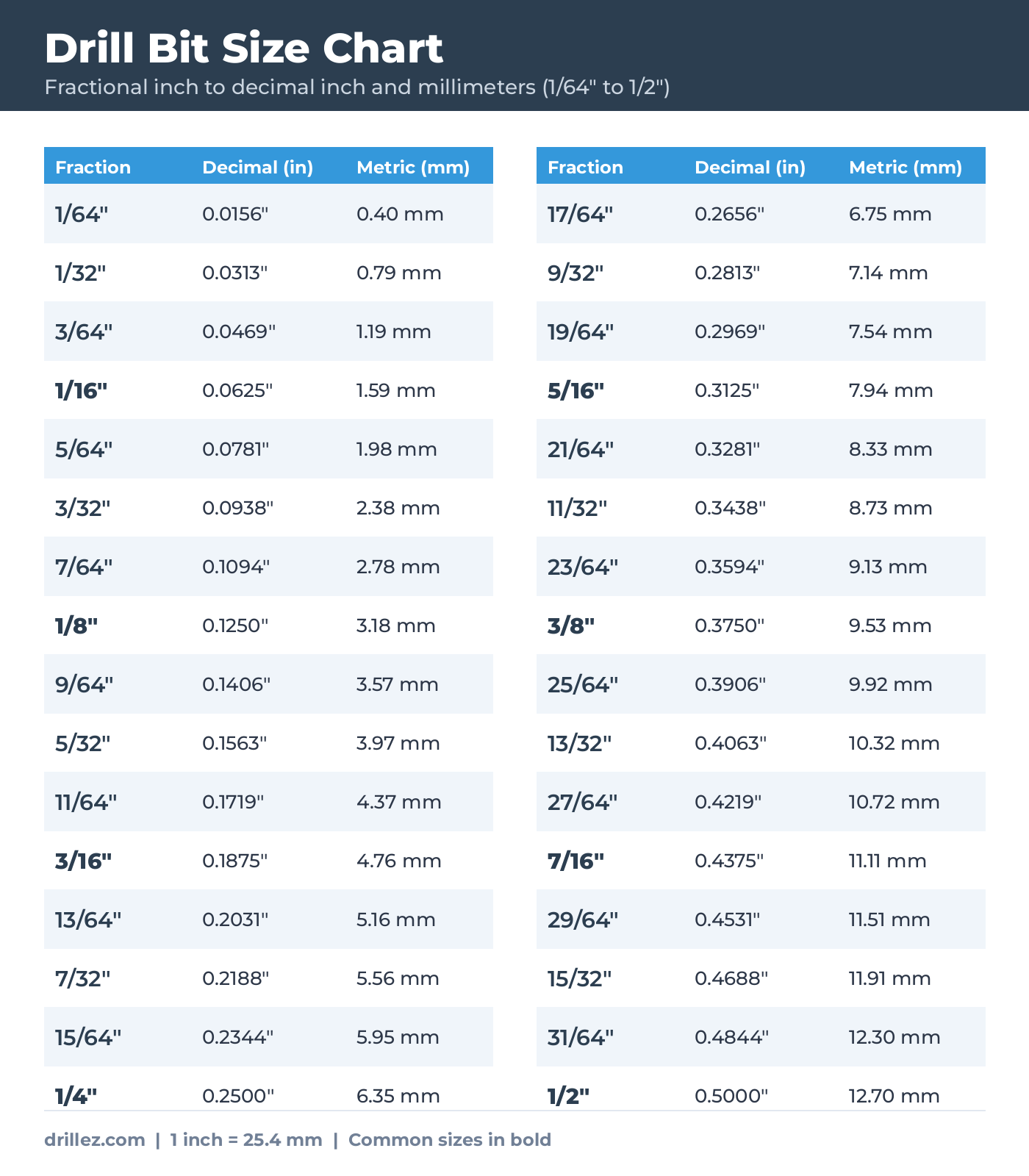
How to Use This Drill Bit Size Chart
- Find your size in the system you have (for example, 5/16″ or 8 mm).
- Read across to the decimal-inch or millimeter equivalent.
- Compare with the bits you own and choose the closest size that suits the job; for tapping, anchors and dowels, use the exact size.
- Save or print the chart above and keep it near your workbench.
How to Print This Chart
Click the chart image near the top of this page to open it at full size, then use your browser’s print option. For a workshop copy, print it on thicker paper or card and pin it near your drill press or workbench. You can also save the image to your phone for quick reference on the job or at the hardware store.
How Drill Bit Sizes Work
| System | How it is written | Where it is used |
|---|---|---|
| Fractional inch | 1/16″, 1/8″, 1/4″, 1/2″ | Most common in the U.S. for wood, metal and general DIY |
| Metric | 3 mm, 6 mm, 10 mm | Most of the world; common on European and Asian bits and hardware |
| Number (wire gauge) | #1 to #80 (larger number = smaller bit) | Machining, metalwork and tap drilling |
| Letter | A to Z (A smallest, Z largest) | Sizes between #1 and 1/2″, mainly for tap drilling |
Number and letter sizes fill the gaps between fractional sizes. They are mainly used in metalworking, where a precise hole size is needed for tapping threads or for press fits.
Fractional Drill Bit Size Chart (Inch to Decimal and mm)
This chart lists every 1/64″ size from 1/64″ to 1″. Common sizes found in most drill bit sets are shown in bold.
| Fraction | Decimal (inch) | Metric (mm) |
|---|---|---|
| 1/64″ | 0.0156″ | 0.40 mm |
| 1/32″ | 0.0313″ | 0.79 mm |
| 3/64″ | 0.0469″ | 1.19 mm |
| 1/16″ | 0.0625″ | 1.59 mm |
| 5/64″ | 0.0781″ | 1.98 mm |
| 3/32″ | 0.0938″ | 2.38 mm |
| 7/64″ | 0.1094″ | 2.78 mm |
| 1/8″ | 0.1250″ | 3.18 mm |
| 9/64″ | 0.1406″ | 3.57 mm |
| 5/32″ | 0.1563″ | 3.97 mm |
| 11/64″ | 0.1719″ | 4.37 mm |
| 3/16″ | 0.1875″ | 4.76 mm |
| 13/64″ | 0.2031″ | 5.16 mm |
| 7/32″ | 0.2188″ | 5.56 mm |
| 15/64″ | 0.2344″ | 5.95 mm |
| 1/4″ | 0.2500″ | 6.35 mm |
| 17/64″ | 0.2656″ | 6.75 mm |
| 9/32″ | 0.2813″ | 7.14 mm |
| 19/64″ | 0.2969″ | 7.54 mm |
| 5/16″ | 0.3125″ | 7.94 mm |
| 21/64″ | 0.3281″ | 8.33 mm |
| 11/32″ | 0.3438″ | 8.73 mm |
| 23/64″ | 0.3594″ | 9.13 mm |
| 3/8″ | 0.3750″ | 9.53 mm |
| 25/64″ | 0.3906″ | 9.92 mm |
| 13/32″ | 0.4063″ | 10.32 mm |
| 27/64″ | 0.4219″ | 10.72 mm |
| 7/16″ | 0.4375″ | 11.11 mm |
| 29/64″ | 0.4531″ | 11.51 mm |
| 15/32″ | 0.4688″ | 11.91 mm |
| 31/64″ | 0.4844″ | 12.30 mm |
| 1/2″ | 0.5000″ | 12.70 mm |
| 33/64″ | 0.5156″ | 13.10 mm |
| 17/32″ | 0.5313″ | 13.49 mm |
| 35/64″ | 0.5469″ | 13.89 mm |
| 9/16″ | 0.5625″ | 14.29 mm |
| 37/64″ | 0.5781″ | 14.68 mm |
| 19/32″ | 0.5938″ | 15.08 mm |
| 39/64″ | 0.6094″ | 15.48 mm |
| 5/8″ | 0.6250″ | 15.88 mm |
| 41/64″ | 0.6406″ | 16.27 mm |
| 21/32″ | 0.6563″ | 16.67 mm |
| 43/64″ | 0.6719″ | 17.07 mm |
| 11/16″ | 0.6875″ | 17.46 mm |
| 45/64″ | 0.7031″ | 17.86 mm |
| 23/32″ | 0.7188″ | 18.26 mm |
| 47/64″ | 0.7344″ | 18.65 mm |
| 3/4″ | 0.7500″ | 19.05 mm |
| 49/64″ | 0.7656″ | 19.45 mm |
| 25/32″ | 0.7813″ | 19.84 mm |
| 51/64″ | 0.7969″ | 20.24 mm |
| 13/16″ | 0.8125″ | 20.64 mm |
| 53/64″ | 0.8281″ | 21.03 mm |
| 27/32″ | 0.8438″ | 21.43 mm |
| 55/64″ | 0.8594″ | 21.83 mm |
| 7/8″ | 0.8750″ | 22.23 mm |
| 57/64″ | 0.8906″ | 22.62 mm |
| 29/32″ | 0.9063″ | 23.02 mm |
| 59/64″ | 0.9219″ | 23.42 mm |
| 15/16″ | 0.9375″ | 23.81 mm |
| 61/64″ | 0.9531″ | 24.21 mm |
| 31/32″ | 0.9688″ | 24.61 mm |
| 63/64″ | 0.9844″ | 25.00 mm |
| 1″ | 1.0000″ | 25.40 mm |
Larger fractional sizes (1-1/16″ to 2″)
Bits larger than 1″ are usually reduced-shank twist bits, spade bits, Forstner bits or hole saws.
| Fraction | Decimal (inch) | Metric (mm) |
|---|---|---|
| 1-1/16″ | 1.0625″ | 26.99 mm |
| 1-1/8″ | 1.1250″ | 28.58 mm |
| 1-3/16″ | 1.1875″ | 30.16 mm |
| 1-1/4″ | 1.2500″ | 31.75 mm |
| 1-5/16″ | 1.3125″ | 33.34 mm |
| 1-3/8″ | 1.3750″ | 34.92 mm |
| 1-7/16″ | 1.4375″ | 36.51 mm |
| 1-1/2″ | 1.5000″ | 38.10 mm |
| 1-9/16″ | 1.5625″ | 39.69 mm |
| 1-5/8″ | 1.6250″ | 41.28 mm |
| 1-11/16″ | 1.6875″ | 42.86 mm |
| 1-3/4″ | 1.7500″ | 44.45 mm |
| 1-13/16″ | 1.8125″ | 46.04 mm |
| 1-7/8″ | 1.8750″ | 47.63 mm |
| 1-15/16″ | 1.9375″ | 49.21 mm |
| 2″ | 2.0000″ | 50.80 mm |
Metric Drill Bit Size Chart (mm to Inch)
Use this chart when your hardware or instructions give a metric size but you own fractional bits. The last column shows the nearest 1/64″ fractional size; check whether a slightly larger or smaller bit suits your job.
| Metric size | Decimal (inch) | Nearest fractional |
|---|---|---|
| 1.0 mm | 0.0394″ | 3/64″ |
| 1.5 mm | 0.0591″ | 1/16″ |
| 2.0 mm | 0.0787″ | 5/64″ |
| 2.5 mm | 0.0984″ | 3/32″ |
| 3.0 mm | 0.1181″ | 1/8″ |
| 3.5 mm | 0.1378″ | 9/64″ |
| 4.0 mm | 0.1575″ | 5/32″ |
| 4.5 mm | 0.1772″ | 11/64″ |
| 5.0 mm | 0.1969″ | 13/64″ |
| 5.5 mm | 0.2165″ | 7/32″ |
| 6.0 mm | 0.2362″ | 15/64″ |
| 6.5 mm | 0.2559″ | 1/4″ |
| 7.0 mm | 0.2756″ | 9/32″ |
| 7.5 mm | 0.2953″ | 19/64″ |
| 8.0 mm | 0.3150″ | 5/16″ |
| 8.5 mm | 0.3346″ | 21/64″ |
| 9.0 mm | 0.3543″ | 23/64″ |
| 9.5 mm | 0.3740″ | 3/8″ |
| 10.0 mm | 0.3937″ | 25/64″ |
| 10.5 mm | 0.4134″ | 13/32″ |
| 11.0 mm | 0.4331″ | 7/16″ |
| 11.5 mm | 0.4528″ | 29/64″ |
| 12.0 mm | 0.4724″ | 15/32″ |
| 12.5 mm | 0.4921″ | 31/64″ |
| 13.0 mm | 0.5118″ | 33/64″ |
Detailed metric chart (0.1 mm steps, 1.0 to 13.0 mm)
Metric bits are sold in 0.1 mm or 0.5 mm steps. This detailed chart is useful for tap drills such as 4.2 mm, 6.8 mm and 8.5 mm.
| Metric | Decimal (in) | Metric | Decimal (in) |
|---|---|---|---|
| 1.0 mm | 0.0394″ | 7.1 mm | 0.2795″ |
| 1.1 mm | 0.0433″ | 7.2 mm | 0.2835″ |
| 1.2 mm | 0.0472″ | 7.3 mm | 0.2874″ |
| 1.3 mm | 0.0512″ | 7.4 mm | 0.2913″ |
| 1.4 mm | 0.0551″ | 7.5 mm | 0.2953″ |
| 1.5 mm | 0.0591″ | 7.6 mm | 0.2992″ |
| 1.6 mm | 0.0630″ | 7.7 mm | 0.3031″ |
| 1.7 mm | 0.0669″ | 7.8 mm | 0.3071″ |
| 1.8 mm | 0.0709″ | 7.9 mm | 0.3110″ |
| 1.9 mm | 0.0748″ | 8.0 mm | 0.3150″ |
| 2.0 mm | 0.0787″ | 8.1 mm | 0.3189″ |
| 2.1 mm | 0.0827″ | 8.2 mm | 0.3228″ |
| 2.2 mm | 0.0866″ | 8.3 mm | 0.3268″ |
| 2.3 mm | 0.0906″ | 8.4 mm | 0.3307″ |
| 2.4 mm | 0.0945″ | 8.5 mm | 0.3346″ |
| 2.5 mm | 0.0984″ | 8.6 mm | 0.3386″ |
| 2.6 mm | 0.1024″ | 8.7 mm | 0.3425″ |
| 2.7 mm | 0.1063″ | 8.8 mm | 0.3465″ |
| 2.8 mm | 0.1102″ | 8.9 mm | 0.3504″ |
| 2.9 mm | 0.1142″ | 9.0 mm | 0.3543″ |
| 3.0 mm | 0.1181″ | 9.1 mm | 0.3583″ |
| 3.1 mm | 0.1220″ | 9.2 mm | 0.3622″ |
| 3.2 mm | 0.1260″ | 9.3 mm | 0.3661″ |
| 3.3 mm | 0.1299″ | 9.4 mm | 0.3701″ |
| 3.4 mm | 0.1339″ | 9.5 mm | 0.3740″ |
| 3.5 mm | 0.1378″ | 9.6 mm | 0.3780″ |
| 3.6 mm | 0.1417″ | 9.7 mm | 0.3819″ |
| 3.7 mm | 0.1457″ | 9.8 mm | 0.3858″ |
| 3.8 mm | 0.1496″ | 9.9 mm | 0.3898″ |
| 3.9 mm | 0.1535″ | 10.0 mm | 0.3937″ |
| 4.0 mm | 0.1575″ | 10.1 mm | 0.3976″ |
| 4.1 mm | 0.1614″ | 10.2 mm | 0.4016″ |
| 4.2 mm | 0.1654″ | 10.3 mm | 0.4055″ |
| 4.3 mm | 0.1693″ | 10.4 mm | 0.4094″ |
| 4.4 mm | 0.1732″ | 10.5 mm | 0.4134″ |
| 4.5 mm | 0.1772″ | 10.6 mm | 0.4173″ |
| 4.6 mm | 0.1811″ | 10.7 mm | 0.4213″ |
| 4.7 mm | 0.1850″ | 10.8 mm | 0.4252″ |
| 4.8 mm | 0.1890″ | 10.9 mm | 0.4291″ |
| 4.9 mm | 0.1929″ | 11.0 mm | 0.4331″ |
| 5.0 mm | 0.1969″ | 11.1 mm | 0.4370″ |
| 5.1 mm | 0.2008″ | 11.2 mm | 0.4409″ |
| 5.2 mm | 0.2047″ | 11.3 mm | 0.4449″ |
| 5.3 mm | 0.2087″ | 11.4 mm | 0.4488″ |
| 5.4 mm | 0.2126″ | 11.5 mm | 0.4528″ |
| 5.5 mm | 0.2165″ | 11.6 mm | 0.4567″ |
| 5.6 mm | 0.2205″ | 11.7 mm | 0.4606″ |
| 5.7 mm | 0.2244″ | 11.8 mm | 0.4646″ |
| 5.8 mm | 0.2283″ | 11.9 mm | 0.4685″ |
| 5.9 mm | 0.2323″ | 12.0 mm | 0.4724″ |
| 6.0 mm | 0.2362″ | 12.1 mm | 0.4764″ |
| 6.1 mm | 0.2402″ | 12.2 mm | 0.4803″ |
| 6.2 mm | 0.2441″ | 12.3 mm | 0.4843″ |
| 6.3 mm | 0.2480″ | 12.4 mm | 0.4882″ |
| 6.4 mm | 0.2520″ | 12.5 mm | 0.4921″ |
| 6.5 mm | 0.2559″ | 12.6 mm | 0.4961″ |
| 6.6 mm | 0.2598″ | 12.7 mm | 0.5000″ |
| 6.7 mm | 0.2638″ | 12.8 mm | 0.5039″ |
| 6.8 mm | 0.2677″ | 12.9 mm | 0.5079″ |
| 6.9 mm | 0.2717″ | 13.0 mm | 0.5118″ |
| 7.0 mm | 0.2756″ |
Larger metric sizes (13.5 to 25 mm)
| Metric size | Decimal (inch) | Nearest fractional |
|---|---|---|
| 13.5 mm | 0.5315″ | 17/32″ |
| 14.0 mm | 0.5512″ | 35/64″ |
| 14.5 mm | 0.5709″ | 37/64″ |
| 15.0 mm | 0.5906″ | 19/32″ |
| 15.5 mm | 0.6102″ | 39/64″ |
| 16.0 mm | 0.6299″ | 5/8″ |
| 16.5 mm | 0.6496″ | 21/32″ |
| 17.0 mm | 0.6693″ | 43/64″ |
| 17.5 mm | 0.6890″ | 11/16″ |
| 18.0 mm | 0.7087″ | 45/64″ |
| 18.5 mm | 0.7283″ | 47/64″ |
| 19.0 mm | 0.7480″ | 3/4″ |
| 19.5 mm | 0.7677″ | 49/64″ |
| 20.0 mm | 0.7874″ | 25/32″ |
| 20.5 mm | 0.8071″ | 13/16″ |
| 21.0 mm | 0.8268″ | 53/64″ |
| 21.5 mm | 0.8465″ | 27/32″ |
| 22.0 mm | 0.8661″ | 55/64″ |
| 22.5 mm | 0.8858″ | 57/64″ |
| 23.0 mm | 0.9055″ | 29/32″ |
| 23.5 mm | 0.9252″ | 59/64″ |
| 24.0 mm | 0.9449″ | 15/16″ |
| 24.5 mm | 0.9646″ | 31/32″ |
| 25.0 mm | 0.9843″ | 63/64″ |
Number Drill Bit Size Chart (#1 to #80)
Number drills run in reverse: the larger the number, the smaller the bit. #1 is 0.2280″ and #80 is 0.0135″. Sizes #1 to #60 are shown first, followed by the smaller #61 to #80.
| Number | Decimal (in) | mm | Number | Decimal (in) | mm |
|---|---|---|---|---|---|
| #1 | 0.2280″ | 5.79 mm | #31 | 0.1200″ | 3.05 mm |
| #2 | 0.2210″ | 5.61 mm | #32 | 0.1160″ | 2.95 mm |
| #3 | 0.2130″ | 5.41 mm | #33 | 0.1130″ | 2.87 mm |
| #4 | 0.2090″ | 5.31 mm | #34 | 0.1110″ | 2.82 mm |
| #5 | 0.2055″ | 5.22 mm | #35 | 0.1100″ | 2.79 mm |
| #6 | 0.2040″ | 5.18 mm | #36 | 0.1065″ | 2.71 mm |
| #7 | 0.2010″ | 5.11 mm | #37 | 0.1040″ | 2.64 mm |
| #8 | 0.1990″ | 5.05 mm | #38 | 0.1015″ | 2.58 mm |
| #9 | 0.1960″ | 4.98 mm | #39 | 0.0995″ | 2.53 mm |
| #10 | 0.1935″ | 4.91 mm | #40 | 0.0980″ | 2.49 mm |
| #11 | 0.1910″ | 4.85 mm | #41 | 0.0960″ | 2.44 mm |
| #12 | 0.1890″ | 4.80 mm | #42 | 0.0935″ | 2.37 mm |
| #13 | 0.1850″ | 4.70 mm | #43 | 0.0890″ | 2.26 mm |
| #14 | 0.1820″ | 4.62 mm | #44 | 0.0860″ | 2.18 mm |
| #15 | 0.1800″ | 4.57 mm | #45 | 0.0820″ | 2.08 mm |
| #16 | 0.1770″ | 4.50 mm | #46 | 0.0810″ | 2.06 mm |
| #17 | 0.1730″ | 4.39 mm | #47 | 0.0785″ | 1.99 mm |
| #18 | 0.1695″ | 4.31 mm | #48 | 0.0760″ | 1.93 mm |
| #19 | 0.1660″ | 4.22 mm | #49 | 0.0730″ | 1.85 mm |
| #20 | 0.1610″ | 4.09 mm | #50 | 0.0700″ | 1.78 mm |
| #21 | 0.1590″ | 4.04 mm | #51 | 0.0670″ | 1.70 mm |
| #22 | 0.1570″ | 3.99 mm | #52 | 0.0635″ | 1.61 mm |
| #23 | 0.1540″ | 3.91 mm | #53 | 0.0595″ | 1.51 mm |
| #24 | 0.1520″ | 3.86 mm | #54 | 0.0550″ | 1.40 mm |
| #25 | 0.1495″ | 3.80 mm | #55 | 0.0520″ | 1.32 mm |
| #26 | 0.1470″ | 3.73 mm | #56 | 0.0465″ | 1.18 mm |
| #27 | 0.1440″ | 3.66 mm | #57 | 0.0430″ | 1.09 mm |
| #28 | 0.1405″ | 3.57 mm | #58 | 0.0420″ | 1.07 mm |
| #29 | 0.1360″ | 3.45 mm | #59 | 0.0410″ | 1.04 mm |
| #30 | 0.1285″ | 3.26 mm | #60 | 0.0400″ | 1.02 mm |
Number drills #61 to #80 (wire gauge sizes)
These very small sizes are used for fine metalwork, jewelry, model making and electronics.
| Number | Decimal (in) | mm | Number | Decimal (in) | mm |
|---|---|---|---|---|---|
| #61 | 0.0390″ | 0.99 mm | #71 | 0.0260″ | 0.66 mm |
| #62 | 0.0380″ | 0.97 mm | #72 | 0.0250″ | 0.64 mm |
| #63 | 0.0370″ | 0.94 mm | #73 | 0.0240″ | 0.61 mm |
| #64 | 0.0360″ | 0.91 mm | #74 | 0.0225″ | 0.57 mm |
| #65 | 0.0350″ | 0.89 mm | #75 | 0.0210″ | 0.53 mm |
| #66 | 0.0330″ | 0.84 mm | #76 | 0.0200″ | 0.51 mm |
| #67 | 0.0320″ | 0.81 mm | #77 | 0.0180″ | 0.46 mm |
| #68 | 0.0310″ | 0.79 mm | #78 | 0.0160″ | 0.41 mm |
| #69 | 0.0292″ | 0.74 mm | #79 | 0.0145″ | 0.37 mm |
| #70 | 0.0280″ | 0.71 mm | #80 | 0.0135″ | 0.34 mm |
Letter Drill Bit Size Chart (A to Z)
Letter drills start where number drills end. A is 0.234″ and Z is 0.413″.
| Letter | Decimal (in) | mm | Letter | Decimal (in) | mm |
|---|---|---|---|---|---|
| A | 0.234″ | 5.94 mm | N | 0.302″ | 7.67 mm |
| B | 0.238″ | 6.05 mm | O | 0.316″ | 8.03 mm |
| C | 0.242″ | 6.15 mm | P | 0.323″ | 8.20 mm |
| D | 0.246″ | 6.25 mm | Q | 0.332″ | 8.43 mm |
| E | 0.250″ | 6.35 mm | R | 0.339″ | 8.61 mm |
| F | 0.257″ | 6.53 mm | S | 0.348″ | 8.84 mm |
| G | 0.261″ | 6.63 mm | T | 0.358″ | 9.09 mm |
| H | 0.266″ | 6.76 mm | U | 0.368″ | 9.35 mm |
| I | 0.272″ | 6.91 mm | V | 0.377″ | 9.58 mm |
| J | 0.277″ | 7.04 mm | W | 0.386″ | 9.80 mm |
| K | 0.281″ | 7.14 mm | X | 0.397″ | 10.08 mm |
| L | 0.290″ | 7.37 mm | Y | 0.404″ | 10.26 mm |
| M | 0.295″ | 7.49 mm | Z | 0.413″ | 10.49 mm |
Master Drill Size Chart: All Sizes in Order
This combined chart lists fractional, number, letter and common metric sizes together, sorted from smallest to largest. Use it to find the closest bit when your plans call for one system and you own another.
| Size | System | Decimal (in) | Metric (mm) |
|---|---|---|---|
| #80 | Number | 0.0135″ | 0.34 mm |
| #79 | Number | 0.0145″ | 0.37 mm |
| 1/64″ | Fractional | 0.0156″ | 0.40 mm |
| #78 | Number | 0.0160″ | 0.41 mm |
| #77 | Number | 0.0180″ | 0.46 mm |
| #76 | Number | 0.0200″ | 0.51 mm |
| #75 | Number | 0.0210″ | 0.53 mm |
| #74 | Number | 0.0225″ | 0.57 mm |
| #73 | Number | 0.0240″ | 0.61 mm |
| #72 | Number | 0.0250″ | 0.64 mm |
| #71 | Number | 0.0260″ | 0.66 mm |
| #70 | Number | 0.0280″ | 0.71 mm |
| #69 | Number | 0.0292″ | 0.74 mm |
| #68 | Number | 0.0310″ | 0.79 mm |
| 1/32″ | Fractional | 0.0313″ | 0.79 mm |
| #67 | Number | 0.0320″ | 0.81 mm |
| #66 | Number | 0.0330″ | 0.84 mm |
| #65 | Number | 0.0350″ | 0.89 mm |
| #64 | Number | 0.0360″ | 0.91 mm |
| #63 | Number | 0.0370″ | 0.94 mm |
| #62 | Number | 0.0380″ | 0.97 mm |
| #61 | Number | 0.0390″ | 0.99 mm |
| 1.0 mm | Metric | 0.0394″ | 1.00 mm |
| #60 | Number | 0.0400″ | 1.02 mm |
| #59 | Number | 0.0410″ | 1.04 mm |
| #58 | Number | 0.0420″ | 1.07 mm |
| #57 | Number | 0.0430″ | 1.09 mm |
| #56 | Number | 0.0465″ | 1.18 mm |
| 3/64″ | Fractional | 0.0469″ | 1.19 mm |
| #55 | Number | 0.0520″ | 1.32 mm |
| #54 | Number | 0.0550″ | 1.40 mm |
| 1.5 mm | Metric | 0.0591″ | 1.50 mm |
| #53 | Number | 0.0595″ | 1.51 mm |
| 1/16″ | Fractional | 0.0625″ | 1.59 mm |
| #52 | Number | 0.0635″ | 1.61 mm |
| #51 | Number | 0.0670″ | 1.70 mm |
| #50 | Number | 0.0700″ | 1.78 mm |
| #49 | Number | 0.0730″ | 1.85 mm |
| #48 | Number | 0.0760″ | 1.93 mm |
| 5/64″ | Fractional | 0.0781″ | 1.98 mm |
| #47 | Number | 0.0785″ | 1.99 mm |
| 2.0 mm | Metric | 0.0787″ | 2.00 mm |
| #46 | Number | 0.0810″ | 2.06 mm |
| #45 | Number | 0.0820″ | 2.08 mm |
| #44 | Number | 0.0860″ | 2.18 mm |
| #43 | Number | 0.0890″ | 2.26 mm |
| #42 | Number | 0.0935″ | 2.37 mm |
| 3/32″ | Fractional | 0.0938″ | 2.38 mm |
| #41 | Number | 0.0960″ | 2.44 mm |
| #40 | Number | 0.0980″ | 2.49 mm |
| 2.5 mm | Metric | 0.0984″ | 2.50 mm |
| #39 | Number | 0.0995″ | 2.53 mm |
| #38 | Number | 0.1015″ | 2.58 mm |
| #37 | Number | 0.1040″ | 2.64 mm |
| #36 | Number | 0.1065″ | 2.71 mm |
| 7/64″ | Fractional | 0.1094″ | 2.78 mm |
| #35 | Number | 0.1100″ | 2.79 mm |
| #34 | Number | 0.1110″ | 2.82 mm |
| #33 | Number | 0.1130″ | 2.87 mm |
| #32 | Number | 0.1160″ | 2.95 mm |
| 3.0 mm | Metric | 0.1181″ | 3.00 mm |
| #31 | Number | 0.1200″ | 3.05 mm |
| 1/8″ | Fractional | 0.1250″ | 3.18 mm |
| #30 | Number | 0.1285″ | 3.26 mm |
| #29 | Number | 0.1360″ | 3.45 mm |
| 3.5 mm | Metric | 0.1378″ | 3.50 mm |
| #28 | Number | 0.1405″ | 3.57 mm |
| 9/64″ | Fractional | 0.1406″ | 3.57 mm |
| #27 | Number | 0.1440″ | 3.66 mm |
| #26 | Number | 0.1470″ | 3.73 mm |
| #25 | Number | 0.1495″ | 3.80 mm |
| #24 | Number | 0.1520″ | 3.86 mm |
| #23 | Number | 0.1540″ | 3.91 mm |
| 5/32″ | Fractional | 0.1563″ | 3.97 mm |
| #22 | Number | 0.1570″ | 3.99 mm |
| 4.0 mm | Metric | 0.1575″ | 4.00 mm |
| #21 | Number | 0.1590″ | 4.04 mm |
| #20 | Number | 0.1610″ | 4.09 mm |
| #19 | Number | 0.1660″ | 4.22 mm |
| #18 | Number | 0.1695″ | 4.31 mm |
| 11/64″ | Fractional | 0.1719″ | 4.37 mm |
| #17 | Number | 0.1730″ | 4.39 mm |
| #16 | Number | 0.1770″ | 4.50 mm |
| 4.5 mm | Metric | 0.1772″ | 4.50 mm |
| #15 | Number | 0.1800″ | 4.57 mm |
| #14 | Number | 0.1820″ | 4.62 mm |
| #13 | Number | 0.1850″ | 4.70 mm |
| 3/16″ | Fractional | 0.1875″ | 4.76 mm |
| #12 | Number | 0.1890″ | 4.80 mm |
| #11 | Number | 0.1910″ | 4.85 mm |
| #10 | Number | 0.1935″ | 4.91 mm |
| #9 | Number | 0.1960″ | 4.98 mm |
| 5.0 mm | Metric | 0.1969″ | 5.00 mm |
| #8 | Number | 0.1990″ | 5.05 mm |
| #7 | Number | 0.2010″ | 5.11 mm |
| 13/64″ | Fractional | 0.2031″ | 5.16 mm |
| #6 | Number | 0.2040″ | 5.18 mm |
| #5 | Number | 0.2055″ | 5.22 mm |
| #4 | Number | 0.2090″ | 5.31 mm |
| #3 | Number | 0.2130″ | 5.41 mm |
| 5.5 mm | Metric | 0.2165″ | 5.50 mm |
| 7/32″ | Fractional | 0.2188″ | 5.56 mm |
| #2 | Number | 0.2210″ | 5.61 mm |
| #1 | Number | 0.2280″ | 5.79 mm |
| A | Letter | 0.2340″ | 5.94 mm |
| 15/64″ | Fractional | 0.2344″ | 5.95 mm |
| 6.0 mm | Metric | 0.2362″ | 6.00 mm |
| B | Letter | 0.2380″ | 6.05 mm |
| C | Letter | 0.2420″ | 6.15 mm |
| D | Letter | 0.2460″ | 6.25 mm |
| 1/4″ | Fractional | 0.2500″ | 6.35 mm |
| E | Letter | 0.2500″ | 6.35 mm |
| 6.5 mm | Metric | 0.2559″ | 6.50 mm |
| F | Letter | 0.2570″ | 6.53 mm |
| G | Letter | 0.2610″ | 6.63 mm |
| 17/64″ | Fractional | 0.2656″ | 6.75 mm |
| H | Letter | 0.2660″ | 6.76 mm |
| I | Letter | 0.2720″ | 6.91 mm |
| 7.0 mm | Metric | 0.2756″ | 7.00 mm |
| J | Letter | 0.2770″ | 7.04 mm |
| K | Letter | 0.2810″ | 7.14 mm |
| 9/32″ | Fractional | 0.2813″ | 7.14 mm |
| L | Letter | 0.2900″ | 7.37 mm |
| M | Letter | 0.2950″ | 7.49 mm |
| 7.5 mm | Metric | 0.2953″ | 7.50 mm |
| 19/64″ | Fractional | 0.2969″ | 7.54 mm |
| N | Letter | 0.3020″ | 7.67 mm |
| 5/16″ | Fractional | 0.3125″ | 7.94 mm |
| 8.0 mm | Metric | 0.3150″ | 8.00 mm |
| O | Letter | 0.3160″ | 8.03 mm |
| P | Letter | 0.3230″ | 8.20 mm |
| 21/64″ | Fractional | 0.3281″ | 8.33 mm |
| Q | Letter | 0.3320″ | 8.43 mm |
| 8.5 mm | Metric | 0.3346″ | 8.50 mm |
| R | Letter | 0.3390″ | 8.61 mm |
| 11/32″ | Fractional | 0.3438″ | 8.73 mm |
| S | Letter | 0.3480″ | 8.84 mm |
| 9.0 mm | Metric | 0.3543″ | 9.00 mm |
| T | Letter | 0.3580″ | 9.09 mm |
| 23/64″ | Fractional | 0.3594″ | 9.13 mm |
| U | Letter | 0.3680″ | 9.35 mm |
| 9.5 mm | Metric | 0.3740″ | 9.50 mm |
| 3/8″ | Fractional | 0.3750″ | 9.52 mm |
| V | Letter | 0.3770″ | 9.58 mm |
| W | Letter | 0.3860″ | 9.80 mm |
| 25/64″ | Fractional | 0.3906″ | 9.92 mm |
| 10.0 mm | Metric | 0.3937″ | 10.00 mm |
| X | Letter | 0.3970″ | 10.08 mm |
| Y | Letter | 0.4040″ | 10.26 mm |
| 13/32″ | Fractional | 0.4063″ | 10.32 mm |
| Z | Letter | 0.4130″ | 10.49 mm |
| 10.5 mm | Metric | 0.4134″ | 10.50 mm |
| 27/64″ | Fractional | 0.4219″ | 10.72 mm |
| 11.0 mm | Metric | 0.4331″ | 11.00 mm |
| 7/16″ | Fractional | 0.4375″ | 11.11 mm |
| 11.5 mm | Metric | 0.4528″ | 11.50 mm |
| 29/64″ | Fractional | 0.4531″ | 11.51 mm |
| 15/32″ | Fractional | 0.4688″ | 11.91 mm |
| 12.0 mm | Metric | 0.4724″ | 12.00 mm |
| 31/64″ | Fractional | 0.4844″ | 12.30 mm |
| 12.5 mm | Metric | 0.4921″ | 12.50 mm |
| 1/2″ | Fractional | 0.5000″ | 12.70 mm |
| 13.0 mm | Metric | 0.5118″ | 13.00 mm |
| 33/64″ | Fractional | 0.5156″ | 13.10 mm |
| 17/32″ | Fractional | 0.5313″ | 13.49 mm |
| 35/64″ | Fractional | 0.5469″ | 13.89 mm |
| 9/16″ | Fractional | 0.5625″ | 14.29 mm |
| 37/64″ | Fractional | 0.5781″ | 14.68 mm |
| 19/32″ | Fractional | 0.5938″ | 15.08 mm |
| 39/64″ | Fractional | 0.6094″ | 15.48 mm |
| 5/8″ | Fractional | 0.6250″ | 15.88 mm |
| 41/64″ | Fractional | 0.6406″ | 16.27 mm |
| 21/32″ | Fractional | 0.6563″ | 16.67 mm |
| 43/64″ | Fractional | 0.6719″ | 17.07 mm |
| 11/16″ | Fractional | 0.6875″ | 17.46 mm |
| 45/64″ | Fractional | 0.7031″ | 17.86 mm |
| 23/32″ | Fractional | 0.7188″ | 18.26 mm |
| 47/64″ | Fractional | 0.7344″ | 18.65 mm |
| 3/4″ | Fractional | 0.7500″ | 19.05 mm |
| 49/64″ | Fractional | 0.7656″ | 19.45 mm |
| 25/32″ | Fractional | 0.7813″ | 19.84 mm |
| 51/64″ | Fractional | 0.7969″ | 20.24 mm |
| 13/16″ | Fractional | 0.8125″ | 20.64 mm |
| 53/64″ | Fractional | 0.8281″ | 21.03 mm |
| 27/32″ | Fractional | 0.8438″ | 21.43 mm |
| 55/64″ | Fractional | 0.8594″ | 21.83 mm |
| 7/8″ | Fractional | 0.8750″ | 22.23 mm |
| 57/64″ | Fractional | 0.8906″ | 22.62 mm |
| 29/32″ | Fractional | 0.9063″ | 23.02 mm |
| 59/64″ | Fractional | 0.9219″ | 23.42 mm |
| 15/16″ | Fractional | 0.9375″ | 23.81 mm |
| 61/64″ | Fractional | 0.9531″ | 24.21 mm |
| 31/32″ | Fractional | 0.9688″ | 24.61 mm |
| 63/64″ | Fractional | 0.9844″ | 25.00 mm |
| 1″ | Fractional | 1.0000″ | 25.40 mm |
Tap Drill Size Chart
A tap drill makes the hole that a tap then threads. The sizes below are the commonly recommended tap drills for standard threads (roughly 75% thread engagement). Always check your tap manufacturer’s recommendation, especially for hard materials.
Inch threads (UNC and UNF)
| Thread | Tap drill | Decimal (in) |
|---|---|---|
| #4-40 | #43 | 0.0890″ |
| #6-32 | #36 | 0.1065″ |
| #8-32 | #29 | 0.1360″ |
| #10-24 | #25 | 0.1495″ |
| #10-32 | #21 | 0.1590″ |
| 1/4″-20 | #7 | 0.2010″ |
| 1/4″-28 | #3 | 0.2130″ |
| 5/16″-18 | F | 0.2570″ |
| 5/16″-24 | I | 0.2720″ |
| 3/8″-16 | 5/16″ | 0.3125″ |
| 3/8″-24 | Q | 0.3320″ |
| 7/16″-14 | U | 0.3680″ |
| 7/16″-20 | 25/64″ | 0.3906″ |
| 1/2″-13 | 27/64″ | 0.4219″ |
| 1/2″-20 | 29/64″ | 0.4531″ |
| 5/8″-11 | 17/32″ | 0.5313″ |
| 3/4″-10 | 21/32″ | 0.6563″ |
Metric threads (coarse)
| Thread | Tap drill |
|---|---|
| M3 x 0.5 | 2.5 mm |
| M4 x 0.7 | 3.3 mm |
| M5 x 0.8 | 4.2 mm |
| M6 x 1.0 | 5.0 mm |
| M8 x 1.25 | 6.8 mm |
| M10 x 1.5 | 8.5 mm |
| M12 x 1.75 | 10.2 mm |
A quick rule for metric coarse threads: tap drill size ≈ thread diameter minus pitch. For example, M8 x 1.25 needs about 8 − 1.25 = 6.75 mm, so a 6.8 mm drill is used.
Machine Screw Clearance Hole Chart
A clearance hole lets a machine screw or bolt pass through a part without threading into it. A close fit gives accurate location; a free fit allows a little play for easier assembly. These are commonly used sizes; check your drawings or standards for critical work.
| Screw size | Close fit | Free fit |
|---|---|---|
| #4 | #33 (0.1130″) | #29 (0.1360″) |
| #6 | #28 (0.1405″) | #25 (0.1495″) |
| #8 | #19 (0.1660″) | #16 (0.1770″) |
| #10 | #11 (0.1910″) | #7 (0.2010″) |
| 1/4″ | F (0.2570″) | H (0.2660″) |
| 5/16″ | P (0.3230″) | Q (0.3320″) |
| 3/8″ | W (0.3860″) | X (0.3970″) |
| 1/2″ | 33/64″ (0.5156″) | 17/32″ (0.5313″) |
Pipe threads (NPT)
Tapered pipe threads need larger tap drills. These are the commonly recommended sizes; check your tap’s instructions.
| Pipe thread | Tap drill |
|---|---|
| 1/8″-27 NPT | R (0.339″) |
| 1/4″-18 NPT | 7/16″ |
| 3/8″-18 NPT | 37/64″ |
| 1/2″-14 NPT | 23/32″ |
| 3/4″-14 NPT | 59/64″ |
Wood Screw Pilot Hole and Clearance Hole Chart
A pilot hole helps a screw thread into wood without splitting it. A clearance hole in the top board lets the screw pass through freely so it can pull the boards tightly together. The sizes below are typical starting points; screw designs vary, so test on scrap wood and follow the screw maker’s guidance when given.
| Screw size | Pilot hole (softwood) | Pilot hole (hardwood) | Clearance hole |
|---|---|---|---|
| #4 | 1/16″ | 5/64″ | 1/8″ |
| #6 | 5/64″ | 3/32″ | 9/64″ |
| #8 | 3/32″ | 1/8″ | 11/64″ |
| #10 | 7/64″ | 9/64″ | 3/16″ |
| #12 | 1/8″ | 9/64″ | 7/32″ |
- Use a slightly larger pilot hole in dense hardwoods and near board ends to prevent splitting.
- For many modern self-drilling wood screws, a pilot hole may not be needed in softwood.
- A countersink bit drills the pilot hole and the recess for the screw head in one step.
Common Drill Bit Sizes for Everyday Jobs
| Job | Typical size | Note |
|---|---|---|
| Small wall plug (anchor) | Size printed on the plug packaging | Often 3/16″ or 1/4″ (5–6 mm) |
| Shelf-pin holes | 1/4″ or 5 mm | Match your shelf pins |
| Dowel joints | Match the dowel (1/4″, 5/16″, 3/8″) | Use a brad-point bit |
| Concealed cabinet hinge cup | 35 mm | Use a Forstner bit |
| Door knob (cross bore) | 2-1/8″ | Hole saw or Forstner bit |
| Door latch (edge bore) | 1″ | Spade or Forstner bit |
For anchors and fixings, always use the bit size printed on the packaging — a hole that is too large will not hold.
Choosing the Nearest, Larger or Smaller Bit
- Closest size: fine for general holes, pilot holes and clearance holes.
- Equal or larger: choose this for clearance holes, so a screw or bolt passes through freely.
- Equal or smaller: choose this for pilot holes and tap drills, where the screw or tap must bite into the material.
- Exact size: required for anchors, dowels, bushings and tapped threads — follow the product instructions.
Nominal Drill Size vs Finished Hole Size
The size marked on a drill bit is its nominal diameter. The hole it drills is often slightly larger, because of bit wobble, chuck runout, sharpening and the material itself. Soft woods and plastics can also close up slightly after drilling. For most DIY work this does not matter, but for press fits, dowels and precision metalwork, test on scrap first. When an exact size is critical, machinists drill slightly undersize and finish with a reamer.
Drill Size Lookup Examples
Example 1: What is a #7 drill in inches and mm?
A #7 drill is 0.2010″, or 5.11 mm. It is the standard tap drill for a 1/4″-20 thread.
Example 2: I need a 1/4″ hole but only have metric bits
1/4″ is 6.35 mm. A 6.5 mm bit is the closest common metric size and will give a slightly larger hole; a 6 mm bit will give a slightly smaller one.
Example 3: My plans call for a 6.4 mm hole
6.4 mm is 0.2520″. The closest inch sizes are 1/4″ (0.2500″) and the letter E drill (0.2500″), or the F drill (0.2570″) if you need slightly larger.
How to Convert Drill Sizes Yourself
- Fraction to decimal: divide the top number by the bottom number. 5/16 = 5 ÷ 16 = 0.3125″.
- Inches to millimeters: multiply by 25.4. 0.3125″ × 25.4 = 7.94 mm.
- Millimeters to inches: divide by 25.4. 8 mm ÷ 25.4 = 0.3150″.
- Decimal to nearest 64th: multiply by 64 and round. 0.3150 × 64 = 20.2, so the nearest size is 20/64″ = 5/16″.
Quick conversions to remember
- 1/16″ ≈ 1.6 mm
- 1/8″ ≈ 3.2 mm
- 3/16″ ≈ 4.8 mm
- 1/4″ ≈ 6.4 mm
- 5/16″ ≈ 7.9 mm
- 3/8″ ≈ 9.5 mm
- 1/2″ ≈ 12.7 mm
- 1″ = 25.4 mm
How to Measure a Drill Bit
- Check the shank: most bits have the size stamped or laser-etched near the shank.
- Changing bits? See how to change a drill bit for every chuck type.
- Use a drill gauge: an inexpensive drill index gauge has labeled holes; find the smallest hole the bit fits through.
- Use calipers: measure across the cutting edges near the tip (not across the flutes) for the most accurate reading, then compare the reading with the decimal charts above.
How to Read a Drill Index
A drill index is a case with a labeled slot for every bit. Most indexes are marked with the fractional, number, letter or metric size above each slot. Returning bits to the correct slot keeps sizes organized and makes it obvious when a size is missing. Many indexes also double as a drill gauge: push a loose bit through the labeled holes to identify its size.
What Sizes Are in Common Drill Bit Sets?
29-piece fractional set
The classic 29-piece set covers every 1/64″ size from 1/16″ to 1/2″ — 29 bits in total: 1/16″, 5/64″, 3/32″, 7/64″, 1/8″, 9/64″, 5/32″, 11/64″, 3/16″, 13/64″, 7/32″, 15/64″, 1/4″, 17/64″, 9/32″, 19/64″, 5/16″, 21/64″, 11/32″, 23/64″, 3/8″, 25/64″, 13/32″, 27/64″, 7/16″, 29/64″, 15/32″, 31/64″, 1/2″. It is the most useful single set for general drilling in wood, metal and plastic, and it covers most pilot holes and clearance holes for common screws.
115-piece set
A 115-piece set combines the 29 fractional sizes above with 60 number sizes (#1 to #60) and 26 letter sizes (A to Z): 29 + 60 + 26 = 115. It is popular with metalworkers because it includes every common tap drill size.
Smaller starter sets
Compact 13-piece or 14-piece sets usually skip the 1/64″ sizes and step up in 1/32″ or 1/16″ increments. They cover everyday jobs but may not include the exact size needed for tapping or precise fits.
Should You Buy Inch or Metric Drill Bits?
If most of your hardware, plans and anchors use inch sizes, a fractional set (1/16″ to 1/2″) is the most useful. If you work with European furniture, metric hardware or wall anchors labeled in millimeters, add a metric set (1 mm to 10 mm or 13 mm). Metalworkers who tap threads benefit from a full number and letter set, or a 115-piece set that combines fractional, number and letter sizes.
Many people keep a fractional set for general use and buy individual metric or number bits as needed for specific projects.
Typical Size Ranges by Drill Bit Type
| Bit type | Typical size range | Notes |
|---|---|---|
| Twist bits | From tiny number sizes up to about 1/2″ in standard sets; larger with reduced shanks | The most common bit for wood, metal and plastic |
| Brad-point bits | About 1/8″ to 1/2″ in common sets | Clean holes in wood |
| Spade bits | About 1/4″ to 1-1/2″ | Fast, rough holes in wood |
| Forstner bits | About 1/4″ to 2-1/8″ in common sets; larger singles available | Flat-bottom holes; 35 mm for cabinet hinges |
| Auger bits | About 1/4″ to 1-1/4″ or more | Deep holes in timber |
| Hole saws | About 3/4″ to 6″ and larger | Large round openings |
| Masonry bits | About 1/8″ to 1″ or more | Carbide tip; use with a hammer drill |
| Step bits | Multiple sizes on one bit, often 1/8″ to 1-3/8″ | Thin metal and plastic sheet |
For help choosing bit types for wood, see our guide to the best drill bits for wood.
Drill Bit Lengths Explained
- Jobber length: the standard length found in most sets; a good balance of reach and stiffness.
- Stubby (screw machine) length: shorter and stiffer, so it wanders less and is ideal for metal and tight spaces.
- Taper (long) length: longer flutes for deeper holes.
- Extension and aircraft bits: extra-long bits for reaching through thick material or into awkward places; more prone to flex.
Longer bits flex more, so start the hole with a shorter bit when accuracy matters.
Shank Sizes and Your Drill Chuck
The shank is the part the chuck grips. Most bits up to 3/8″ have a shank the same size as the bit. Larger bits often have reduced shanks (for example, a 1/2″ bit with a 3/8″ shank) so they fit smaller chucks. Hex shanks fit quick-change chucks and impact drivers; SDS shanks fit rotary hammers. Always check that your drill has enough power and the right chuck before choosing large bits — see our corded drill guide.
Tips for Choosing the Right Drill Bit Size
- Start small: for large holes, drill a small pilot hole first, then step up to the final size.
- Match the bit type to the material: brad-point for wood, HSS or cobalt for metal, carbide masonry bits for concrete. See our guide to the types of drill bits. See our guide to the best drill bits for wood.
- Mind your chuck: a 3/8″ chuck holds shanks up to 3/8″; larger bits often have reduced shanks. Learn more in our corded drill guide.
- Concrete and brick: use a hammer drill and masonry bits. See the best hammer drills for concrete.
- Keep bits organized: an indexed case keeps sizes labeled so you always grab the right one.
Frequently Asked Questions
What size drill bit is 1/4 inch in mm?
A 1/4″ drill bit is 6.35 mm. The closest common metric bit is 6.5 mm.
What size is a 1/8 drill bit in mm?
A 1/8″ bit is 3.175 mm, usually rounded to 3.18 mm. The closest metric size is 3 mm or 3.2 mm.
Is a #7 drill bit bigger than 1/4″?
No. A #7 bit is 0.2010″, slightly smaller than 1/4″ (0.2500″). It is the standard tap drill for a 1/4″-20 thread.
Which is bigger, a letter or number drill?
Letter drills are bigger. The largest number drill (#1) is 0.2280″, and the smallest letter drill (A) is 0.2340″.
What is the most common drill bit size?
For general home use, 1/8″, 3/16″ and 1/4″ are among the most frequently used sizes, especially for pilot holes and wall plugs.
How do I convert drill bit sizes from inches to mm?
Multiply the decimal-inch size by 25.4. For example, 0.375″ × 25.4 = 9.525 mm (a 3/8″ bit).
Can I use a metric bit instead of a fractional bit?
Often yes, if the size is close enough for your job. For tapping threads, press fits and anchors, use the exact size recommended.
Why do some charts show slightly different mm values?
Most differences come from rounding. For example, 1/8″ is exactly 3.175 mm; some charts round it to 3.17 mm and others to 3.18 mm. Both describe the same bit.
What drill bit sizes come in a standard set?
Most general-purpose sets cover 1/16″ to 1/4″ or 1/2″ in 1/64″ or 1/32″ steps, often with extra copies of the smallest sizes.
What size drill bit for a 1/4-20 tap?
Use a #7 drill (0.2010″). It is the standard tap drill for a 1/4″-20 UNC thread.
What size drill bit for a 3/8 bolt?
For a clearance hole, use a W drill (0.386″) for a close fit or an X drill (0.397″) for a free fit; 25/64″ (0.391″) is a common fractional choice. For a 3/8″-16 tapped hole, use a 5/16″ tap drill.
What is the smallest standard drill bit size?
In the number system shown here, #80 is 0.0135″. Even smaller micro drills exist for specialist work.
Are drill bit sizes the same as screw sizes?
No. Screw gauges (#6, #8, #10) describe the screw, not the hole. Use the pilot hole and clearance hole charts above to choose the right bit for each screw.
What size drill bit for a #8 wood screw?
As a typical starting point, use a 3/32″ pilot hole in softwood or 1/8″ in hardwood, and an 11/64″ clearance hole in the top board. Test on scrap wood first, because screw designs vary.
Conversions are calculated using 1 inch = 25.4 mm and rounded. Tap drill and pilot hole sizes are common recommendations; always follow the instructions supplied with your tap, screw or anchor.