Cobalt vs Titanium Drill Bits: Which Is Better for Metal?
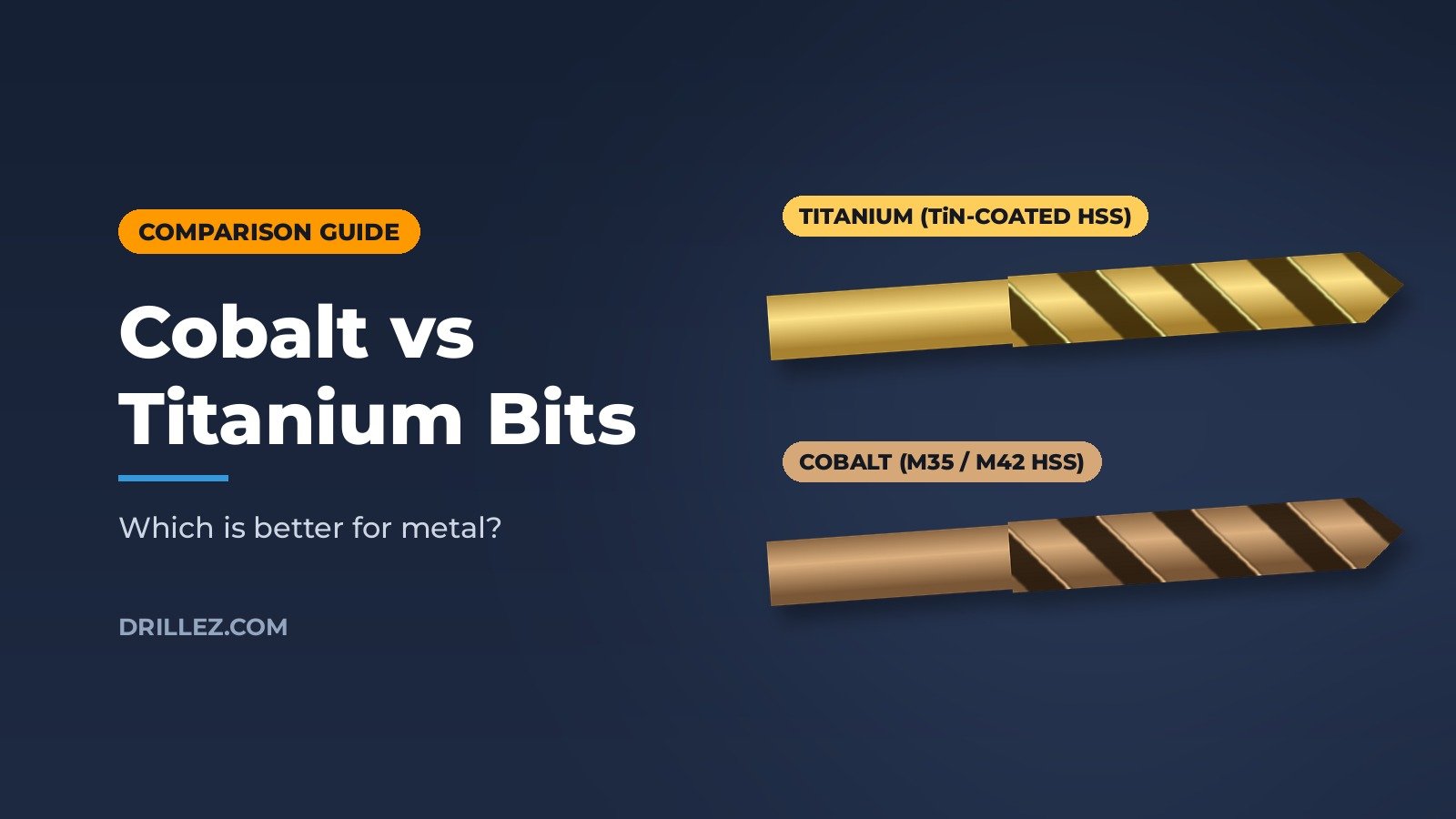
“Titanium” and “cobalt” drill bits are both built for metal, but they work in completely different ways. A titanium bit is ordinary high-speed steel (HSS) with a thin gold coating. A cobalt bit is made from a tougher steel alloy, with cobalt mixed all the way through. That one difference decides which bit you should buy.
Quick answer: for stainless steel, cast iron and other hard metals, buy cobalt: it keeps its edge when it gets hot and can be resharpened. For mild steel, sheet metal, wood and plastic around the house, titanium-coated (TiN) bits are cheaper and work well.
Cobalt vs Titanium at a Glance
What Is a Cobalt Drill Bit?
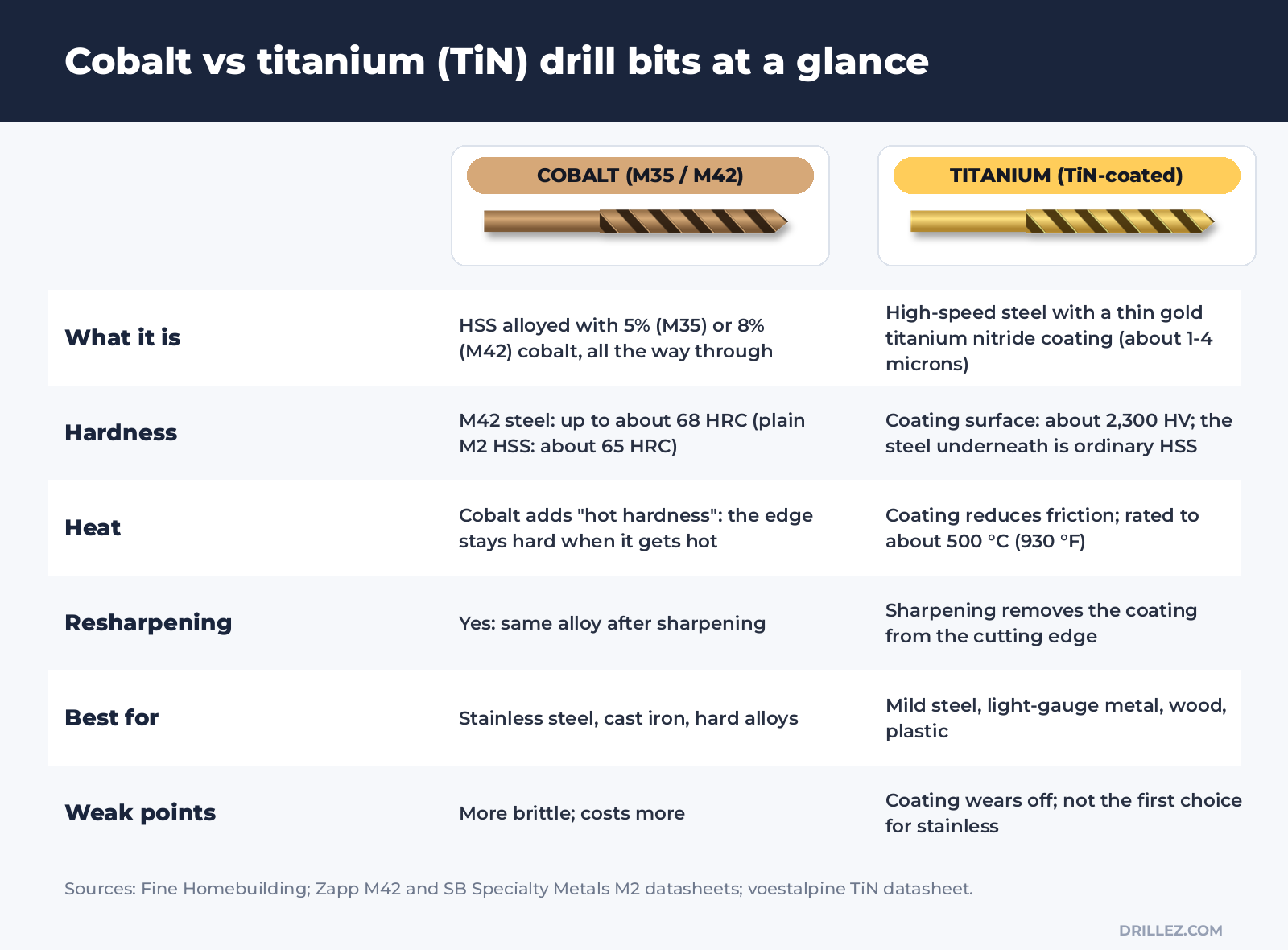
A cobalt bit is not pure cobalt. It is high-speed steel alloyed with cobalt. The two common grades are M35, with about 5% cobalt, and M42, with about 8% cobalt, as Fine Homebuilding explains and steel makers’ datasheets confirm. IRWIN, for example, describes its cobalt bits as M-35, 5 percent cobalt alloy high speed steel.
- Hot hardness: the cobalt helps the steel stay hard at high temperatures. That matters in stainless steel, which creates a lot of heat at the cutting edge.
- Hardness: M42 steel can be hardened to about 68 HRC according to the Zapp datasheet, compared with about 65 HRC for plain M2 high-speed steel.
- Through-hardened: because the cobalt is part of the alloy, the bit is the same material after you sharpen it.
What Is a Titanium Drill Bit?
A “titanium” drill bit is not made of titanium. It is a high-speed steel bit with a titanium nitride (TiN) coating, the gold color you see on many bit sets. According to Fine Homebuilding, the coating is only 1 to 3 microns thick; coating supplier voestalpine lists 1 to 4 microns.
- Hard, slippery surface: voestalpine rates TiN at about 2,300 HV, much harder than the steel underneath, and it reduces friction and heat.
- Temperature limit: the same datasheet lists a maximum working temperature of about 500 °C (930 °F).
- Coating only: the steel inside is ordinary HSS. Once the coating wears through, or you sharpen the bit, the cutting edge behaves like a standard HSS bit.
You may also see darker coatings such as TiCN or TiAlN. These are related coatings, and some premium cobalt bits carry them too, for example Chicago-Latrobe’s TiAlN-coated M42 cobalt bits.
Which Is Better for Each Material?
| Material | Best choice | Why |
|---|---|---|
| Stainless steel | Cobalt | Stainless work-hardens and runs hot; cobalt keeps its edge |
| Cast iron | Cobalt | Abrasive; IRWIN recommends its cobalt bits for it |
| Hardened or alloy steel | Cobalt (M42 for the toughest) | Needs maximum hot hardness |
| Mild steel, angle iron | TiN or cobalt | TiN works well and costs less; cobalt lasts longer |
| Sheet metal, light-gauge steel | TiN | DEWALT describes its TiN bits as ideal for light-gauge metals |
| Aluminum, copper, brass | TiN or plain HSS | Soft metals; use a sharp bit and clear chips often |
| Wood and plastic | TiN or a wood bit | Cobalt is overkill; for clean wood holes see our best drill bits for wood |
| Masonry, tile, glass | Neither | Use carbide masonry, tile or glass bits |
What Manufacturers Claim (and Why the Numbers Differ)
Packaging often promises “2x”, “6x” or even “10x” longer life. These claims are real, but each one compares against a different baseline, so they cannot be compared with each other:
| Bit | Manufacturer claim | Compared with |
|---|---|---|
| DEWALT TiN (DW1328) | 2x longer life | Black oxide bits |
| Bosch TiN | Up to 6x longer | Standard high-speed steel |
| IRWIN TiN | Up to 6x longer | Standard high-speed steel |
| DEWALT Industrial Cobalt (DWA1208) | 4x longer life in stainless steel | Baseline not stated |
| Milwaukee RED HELIX Cobalt | Up to 10x life | Black oxide bits |
The takeaway: a coated or cobalt bit should outlast a plain bit, but the size of the gain depends on the material, speed, pressure and cooling.
How to Tell Cobalt and Titanium Bits Apart
- Gold color usually means a TiN coating.
- Markings on the shank or packaging are more reliable than color. Look for “Cobalt”, “HSS-Co”, “M35” (5%) or “M42” (8%). Industrial cobalt bits are often listed with a straw or bronze finish, but some cobalt bits are coated or painted, so color alone is not proof.
- Price: cobalt bits usually cost more than TiN bits of the same size.
How to Drill Stainless Steel With a Cobalt Bit
Even the best cobalt bit will fail if it is used too fast. Stainless steel work-hardens: if the bit rubs instead of cutting, the surface becomes harder and the bit dulls quickly.
- Clamp the work and mark the center with a center punch.
- Use a slow speed (low gear on a cordless drill). Large bits need slower speeds than small ones.
- Press firmly and steadily so the bit keeps cutting a chip. Do not let it rub or polish the hole.
- Use cutting oil to reduce heat and help the chips form.
- Drill a small pilot hole first for larger holes. DEWALT’s drill manuals suggest pilot holes for large holes in steel.
- Clear chips often and let the bit cool if it starts to discolor.
Not sure what speed setting to use? Our guide to what the numbers on a drill mean explains the 1-2 speed switch and clutch.
Pros and Cons
Cobalt drill bits
- Pros: handles stainless steel and hard metals; keeps its edge when hot; can be resharpened.
- Cons: costs more; harder steel is more brittle, so it can snap if bent or used in a wobbly hand drill.
Titanium (TiN) drill bits
- Pros: cheaper; low-friction coating; great all-round bits for mild steel, wood and plastic.
- Cons: the coating wears; sharpening removes it from the edge; not the first choice for stainless.
Which Should You Buy?
- Home and DIY use: a TiN-coated set covers most jobs in mild steel, wood and plastic.
- Stainless, cast iron or lots of metal work: add a cobalt set (M35 is a good all-rounder; M42 is harder for the toughest metals).
- Best of both: many people keep a TiN set for everyday work and a few cobalt bits in the sizes they use most for stainless.
New to drill bits? Our guide to types of drill bits explains every common type, and the drill bit size chart helps you pick sizes.
Frequently Asked Questions
Is titanium better than cobalt?
Not for hard metals. “Titanium” bits are HSS with a TiN coating, while cobalt bits are a harder, heat-resistant alloy all the way through. Cobalt is better for stainless and hard metals; TiN is a good, cheaper choice for general drilling.
What are the disadvantages of cobalt drill bits?
They cost more, and the harder steel is more brittle, so they can break if bent or forced sideways. They are also unnecessary for wood and plastic.
Can you sharpen titanium drill bits?
Yes, but sharpening removes the TiN coating from the cutting edge, so the sharpened bit performs like a plain HSS bit at the tip.
Can you sharpen cobalt drill bits?
Yes. Because the cobalt is part of the steel, a sharpened cobalt bit keeps its properties.
What is the strongest drill bit material?
Among common twist bits, M42 cobalt is one of the hardest high-speed steels. Solid carbide bits are harder still, but they are brittle and mainly used in rigid machines such as drill presses and CNC mills.
Are cobalt bits good for wood?
They will drill wood, but they are expensive for the job. Brad-point or TiN bits give cleaner, cheaper results in wood.
Summary
Titanium bits are HSS with a thin, hard gold coating; cobalt bits are a harder alloy all the way through. Choose cobalt for stainless steel, cast iron and hard alloys, and drill slowly with cutting oil. Choose TiN for everyday drilling in mild steel, sheet metal, wood and plastic. For most workshops, a TiN set plus a few cobalt bits covers everything.