Types of Drill Bits: 30 Bits Explained and When to Use Each
Walk down the drill bit aisle and you will see dozens of shapes: spirals, paddles, cups, cones and spikes. Each one is designed for a specific material or type of hole, and using the right one is the difference between a clean, accurate hole and a splintered, burned or broken mess.
This guide explains 30 types of drill bits, grouped by the material they are made for — wood, metal, masonry and tile, plus general-purpose and specialty bits. For each one you will learn what it looks like, what it is best for, and one practical tip. At the end, we cover shank types, bit materials and coatings, and how to choose the right bit quickly.
Quick Finder: Which Drill Bit Do You Need?
| Material or job | Best bit type |
|---|---|
| Small holes in wood, metal or plastic | Twist bit |
| Clean, accurate holes in wood | Brad-point bit |
| Fast, rough holes in wood (wiring, plumbing) | Spade bit or self-feed bit |
| Deep holes in thick timber | Auger bit |
| Flat-bottom holes, hinge cups | Forstner bit |
| Large round openings | Hole saw |
| Thin sheet metal and plastic | Step bit |
| Hard metals, stainless steel | Cobalt twist bit |
| Brick, block and concrete | Masonry bit or SDS bit |
| Ceramic tile and glass | Spear-point tile/glass bit |
| Porcelain and stone tile | Diamond core bit |
| Flush screw heads | Countersink bit |
| Hidden screws in plugs | Counterbore bit and plug cutter |
| Pocket-hole joinery | Pocket hole bit |
| Long holes through walls for cables | Installer bit |
Need the right size as well as the right type? See our drill bit size chart.
Parts of a Drill Bit
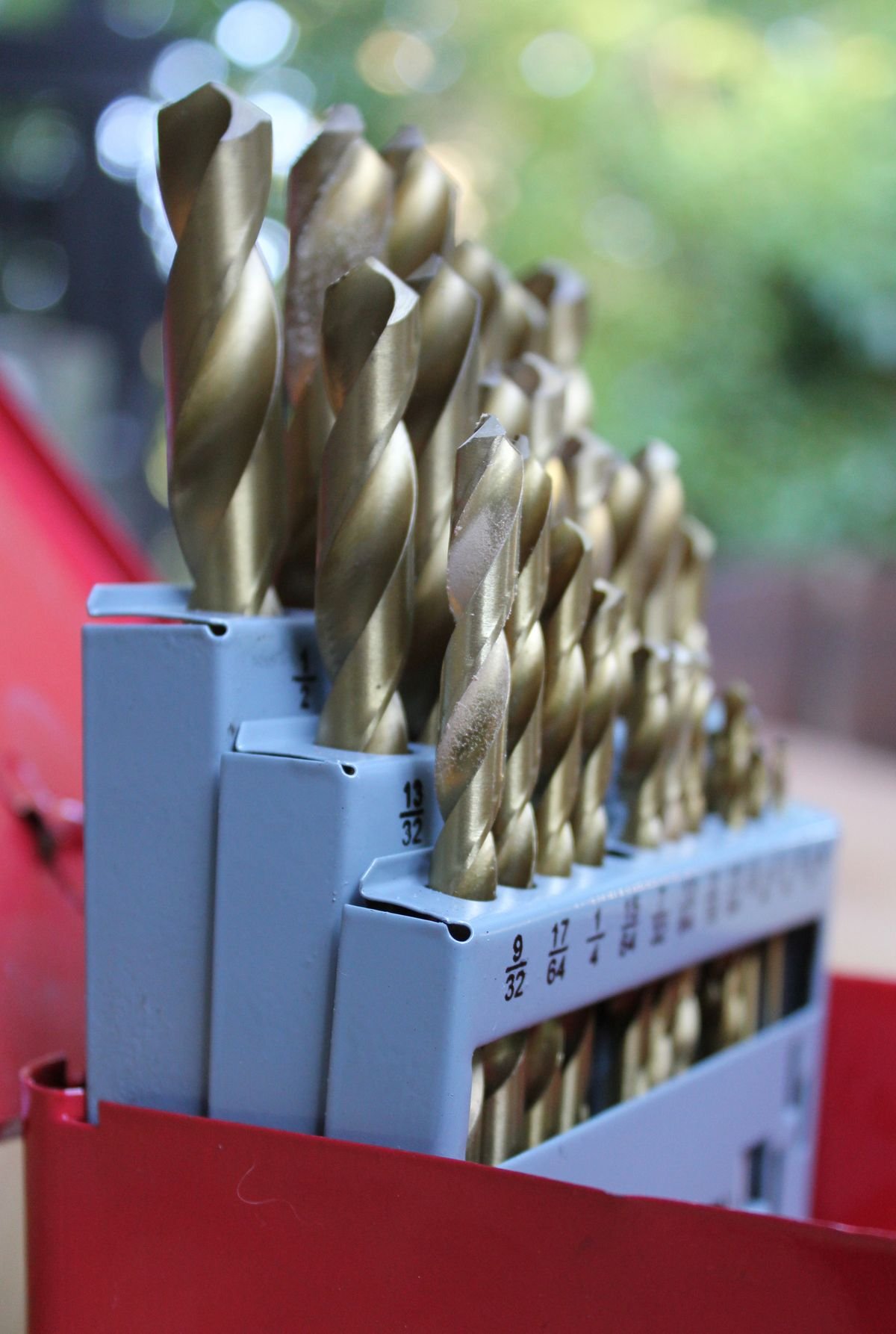
Knowing the parts of a standard twist bit makes it easier to understand why bits behave differently:
- Point: the cone-shaped tip that starts the hole. Its angle (often 118° or 135°) affects how easily it starts and what it cuts best.
- Lips (cutting edges): the two edges at the tip that do the cutting. They must be equal in length for the bit to drill a round, accurate hole.
- Flutes: the spiral grooves that carry chips out of the hole and let coolant in.
- Land and margin: the narrow surfaces along the outside of the flutes that guide the bit and keep it centered.
- Web: the solid core between the flutes that gives the bit strength.
- Shank: the plain end that the drill grips.
General-Purpose Drill Bits
1. Twist drill bit
The most common drill bit. It has a pointed tip and two spiral flutes that carry chips out of the hole. Twist bits are made from carbon steel, high-speed steel (HSS) or cobalt, often with a black oxide or titanium nitride coating.
- Best for: Pilot holes and general drilling in wood, metal and plastic.
- Tip: Use a backer board in wood to stop the exit hole from splintering, and cutting oil in steel.
2. Step drill bit (unibit)
A cone-shaped bit with a series of stepped diameters. One bit drills many hole sizes, and each step leaves a clean, round hole.
- Best for: Thin sheet metal, electrical boxes, plastic panels and enlarging existing holes.
- Tip: Mark the step you need with a marker; the next step up makes a small chamfer that deburrs the hole.
3. Hole saw
A cup-shaped saw with teeth around the rim and a pilot bit in the center. It cuts only the outline of the hole, so a modest drill can make large openings.
- Best for: Large holes for pipes, downlights, door locks and cable entries.
- Tip: Drill from both sides for a clean exit and use low speed.
4. Multi-material bit
A carbide-tipped bit designed to drill wood, metal, plastic, masonry and tile without changing bits.
- Best for: Mixed-material jobs such as fixing to a wall where you may hit wood, brick or tile.
- Tip: Convenient, but a dedicated bit is usually faster and cleaner in any one material.
Drill Bits for Wood
5. Brad-point bit
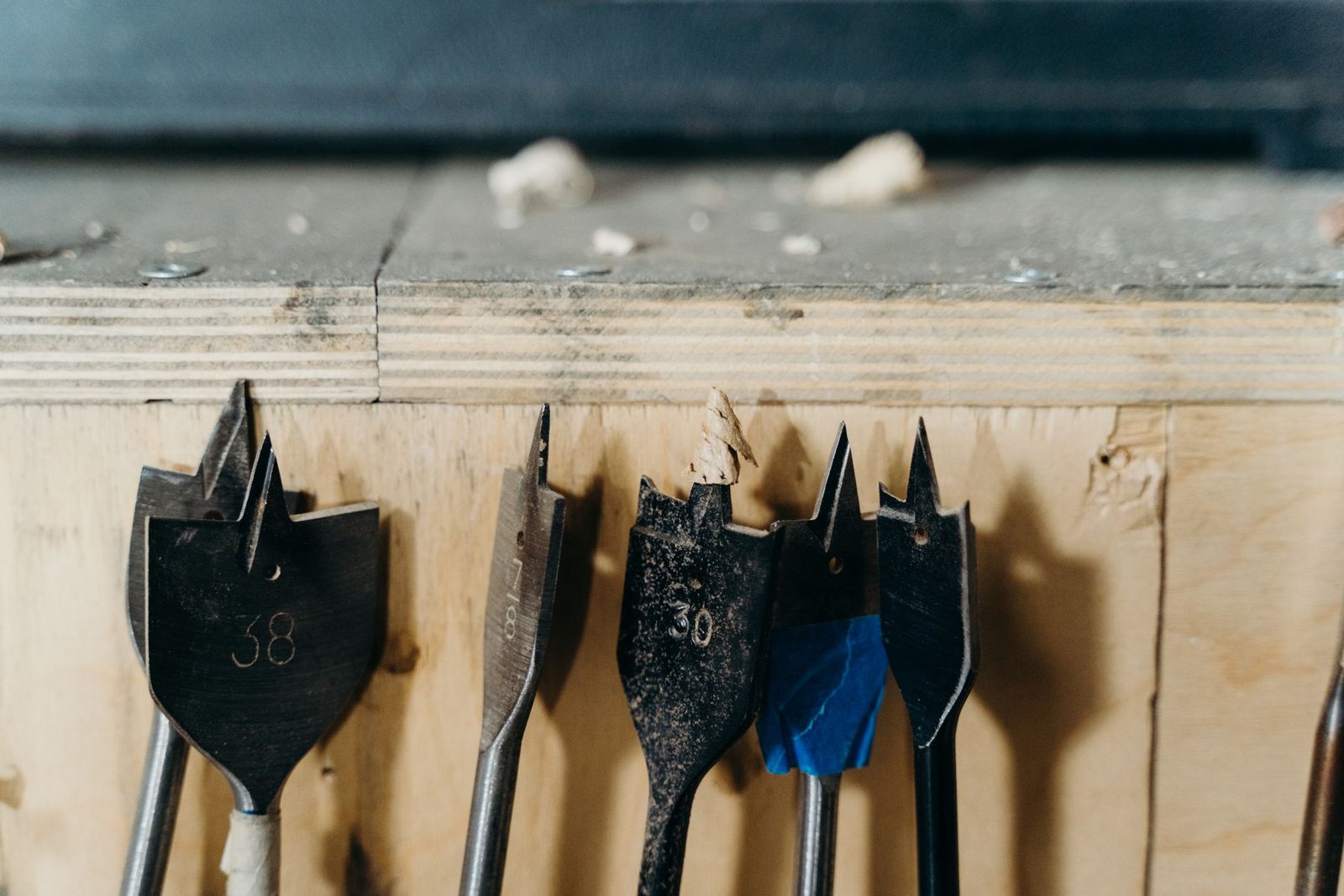
A twist-style bit with a sharp center spike and two outer spurs. The spike locates the hole precisely and the spurs slice the wood fibers before the cutting edges remove material. For specific sets we recommend, see our guide to the best drill bits for wood.
- Best for: Dowel holes, shelf-pin holes and any visible hole in furniture or cabinets.
- Tip: Start slowly so the spike seats exactly on your mark.
6. Spade bit (paddle bit)
A flat paddle with a pointed center and two cutting edges. Spade bits are cheap and fast but leave rough holes.
- Best for: Holes through studs and joists for cables and pipes.
- Tip: Drill until the point breaks through, then finish from the other side to avoid blowout.
7. Self-feed bit
A heavy-duty bit with a threaded screw tip that pulls it into the wood and a cutting rim with spurs. It needs a powerful, low-speed drill.
- Best for: Large holes through framing for plumbing and electrical runs.
- Tip: Use a drill with a side handle; the screw tip pulls hard and can twist the drill.
8. Auger bit
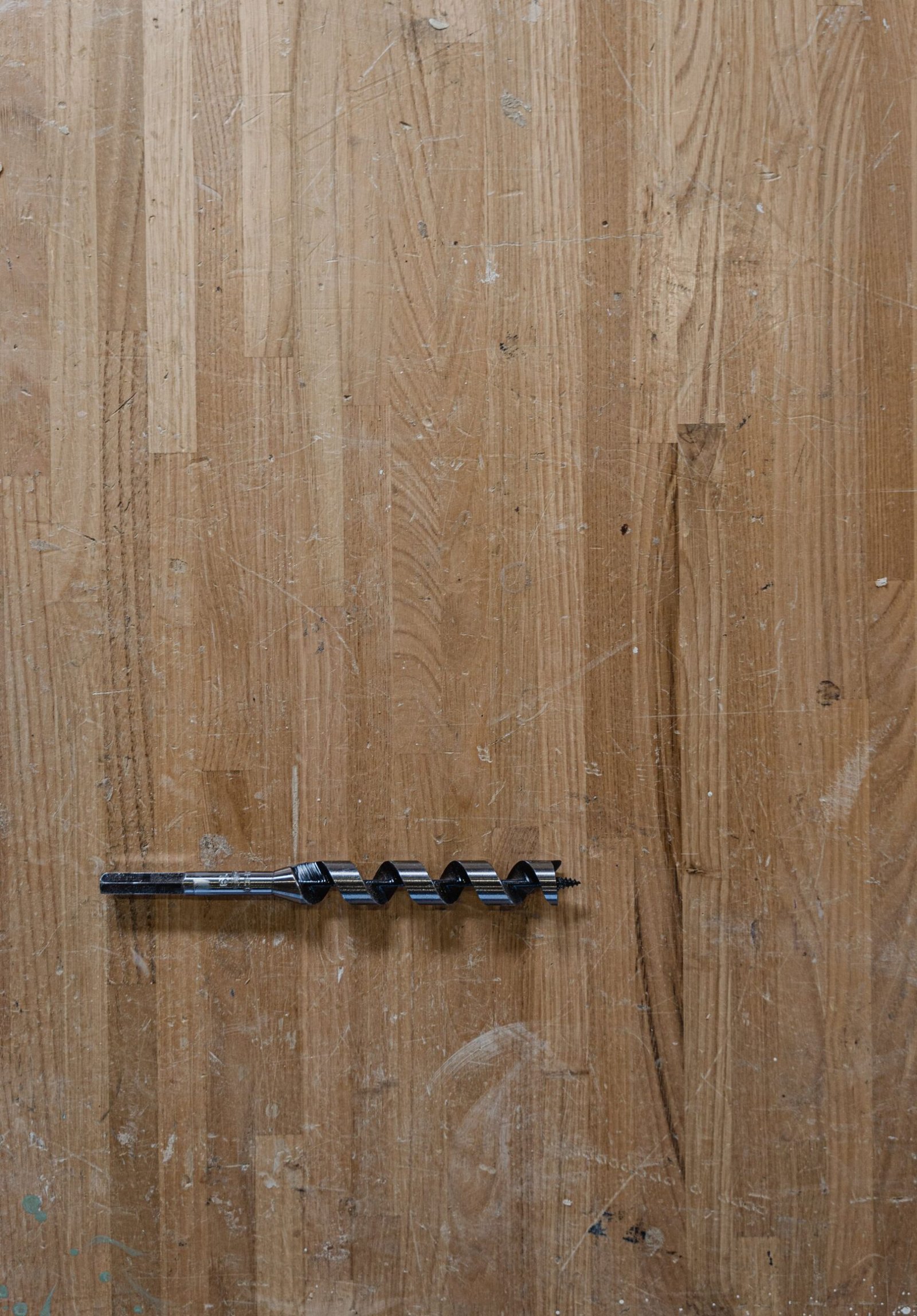
A long bit with a wide spiral and a screw tip that feeds the bit into the wood. The deep flutes clear chips from long holes.
- Best for: Deep holes through posts, beams and thick timber.
- Tip: Back the bit out regularly to clear chips in very deep holes.
9. Forstner bit
A short bit with a rim and a small center spur instead of a long point. It bores very clean, flat-bottomed holes and can drill overlapping or partial holes.
- Best for: Concealed cabinet hinge cups (35 mm), flat-bottom recesses and decorative holes.
- Tip: Work best in a drill press; in a hand drill, keep the drill square and the speed low.
10. Expansive (adjustable) wood bit
A wood bit with an adjustable cutter that lets one bit drill a range of diameters.
- Best for: Occasional large holes in wood when you do not want to buy many large bits.
- Tip: Set and lock the cutter carefully, and test the diameter on scrap first.
11. Circle cutter (adjustable hole cutter)
A pilot bit with an arm and a single cutting tool that swings around in a circle.
- Best for: Large holes in thin wood, plywood and plastic.
- Tip: Use only in a drill press with the work clamped; the single cutter is unbalanced.
12. Plug cutter
A hollow bit that cuts short wooden plugs from scrap wood.
- Best for: Making plugs to hide screw heads in furniture and boat work.
- Tip: Cut plugs from the same wood as your project and match the grain direction.
13. Countersink bit
A cone-shaped cutter, often combined with a pilot drill, that creates a recess so a flat-head screw sits flush.
- Best for: Flush screw heads in furniture, cabinets and decks.
- Tip: Use the countersink angle that matches your screws (see the table below).
14. Counterbore bit
Similar to a countersink but cuts a flat-bottomed recess so the whole screw head sits below the surface.
- Best for: Hiding screws under wooden plugs.
- Tip: Pair with a plug cutter of the same diameter.
15. Pocket hole bit
A stepped bit used with a pocket-hole jig to drill angled holes for joining boards with screws.
- Best for: Face frames, cabinet carcasses and quick furniture joinery.
- Tip: Set the stop collar to match your board thickness and jig instructions.
16. Installer bit (bell hanger bit)
A very long, thin bit with a small hole near the tip. After drilling, you thread a wire through the hole and pull it back through the wall.
- Best for: Running speaker, data or alarm cables through walls and floors.
- Tip: Check for pipes and wires before drilling blind through walls.
17. Self-centering (Vix) bit
A bit inside a spring-loaded sleeve that centers the pilot hole in a hinge or hardware screw hole.
- Best for: Perfectly centered pilot holes for hinges and drawer slides.
- Tip: Choose the size that matches your hinge screws.
Drill Bits for Metal
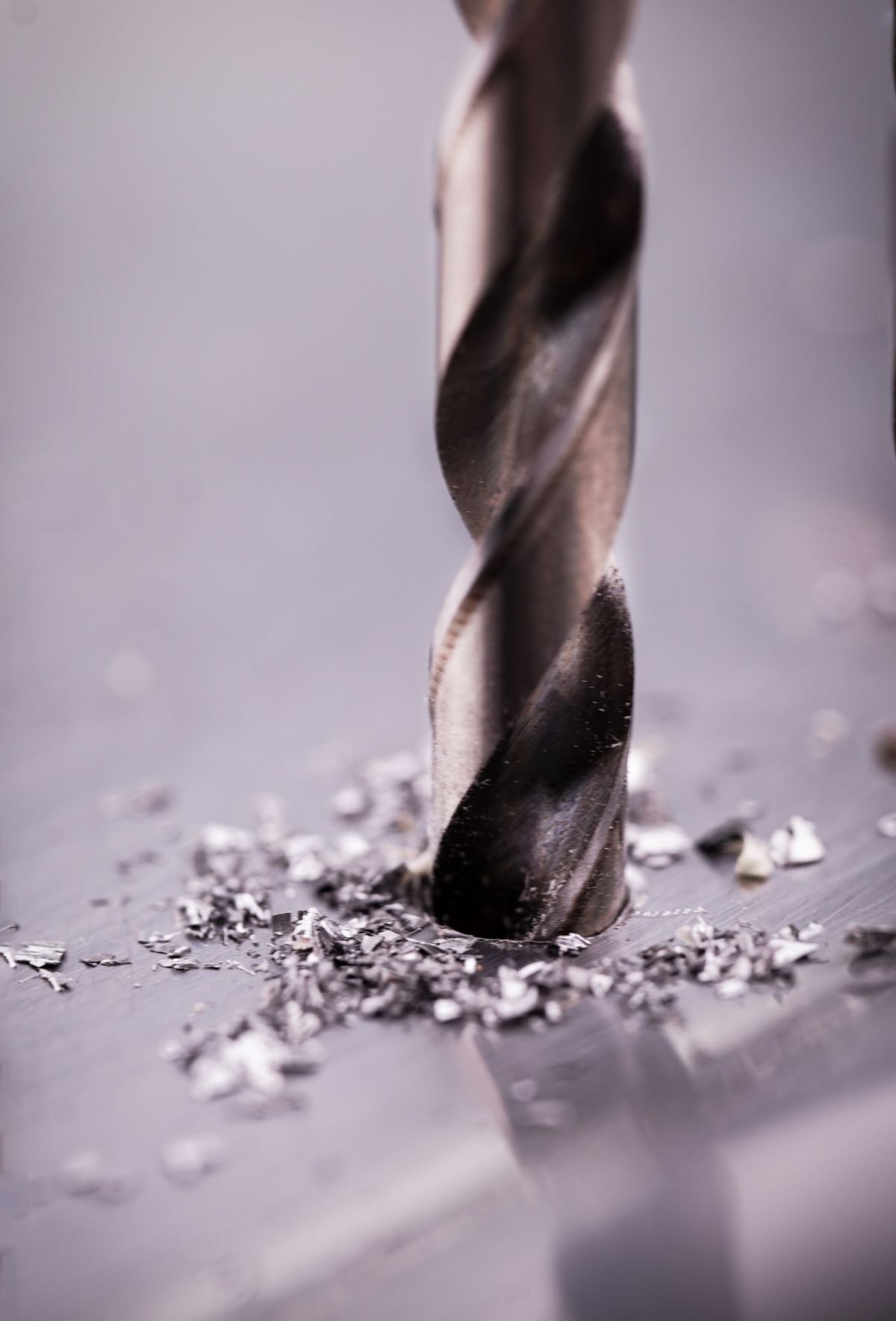
18. High-speed steel (HSS) bit
The standard twist bit for metal. HSS stays harder at higher temperatures than carbon steel, so it lasts longer in metal.
- Best for: Mild steel, aluminum, brass and general metal drilling.
- Tip: Use cutting oil and moderate speed; let the bit cut without forcing it.
19. Cobalt bit
A twist bit made from HSS alloyed with cobalt throughout, commonly M35 (about 5% cobalt) or M42 (about 8% cobalt). It resists heat much better than plain HSS.
- Best for: Stainless steel, hardened steel and other tough metals.
- Tip: Cobalt is harder but more brittle; avoid side loads that can snap the bit.
20. Carbide bit
A bit made from or tipped with tungsten carbide, which is extremely hard and stays sharp in abrasive materials.
- Best for: Hardened steel, cast iron and abrasive materials, usually in rigid setups such as drill presses and machines.
- Tip: Carbide is brittle; use it where the drill is stable and vibration-free.
21. Spot drill and center drill
Short, stiff bits used to make a small starting point so a twist bit does not wander. Center drills also make the conical holes used for lathe centers.
- Best for: Accurate hole location in metal on drill presses, mills and lathes.
- Tip: Spot first, then drill; it greatly improves accuracy on curved or hard surfaces.
22. Straight-flute bit
A bit with straight rather than spiral flutes, which reduces the tendency to grab.
- Best for: Brass, bronze and some plastics, which can grab with standard twist bits.
- Tip: Useful in a drill press when drilling thin brass or acrylic.
23. Annular cutter
A hollow, cup-shaped cutter that removes only a ring of material, used in magnetic drills.
- Best for: Large, accurate holes in structural steel.
- Tip: Requires a magnetic drill and cutting fluid.
24. Rivet drill bit
A short, stiff twist bit sized for common rivet diameters.
- Best for: Drilling rivet holes in sheet metal for auto body, HVAC and trailer work.
- Tip: The short length reduces flexing and breakage in thin metal.
Drill Bits for Masonry, Concrete, Tile and Glass
25. Masonry bit
A twist bit with a carbide tip brazed onto the end. Used with a hammer drill, it chips its way through brick, block and concrete. For setup and technique, see how to use a hammer drill.
- Best for: Anchor holes and wall plugs in brick, block and concrete. See how to drill into a concrete wall for bit sizes by anchor.
- Tip: Switch on hammer mode and clear dust often. Never use masonry bits on metal.
26. SDS-plus and SDS-max bits
Masonry bits with grooved shanks that lock into rotary hammers. The bit can slide back and forth, so the hammer blows transfer efficiently.
- Best for: Fast drilling in concrete, especially many holes or larger holes.
- Tip: SDS-plus fits most rotary hammers; SDS-max is for larger, heavy-duty tools.
27. Core bit
A hollow bit with diamond or carbide teeth that cuts a cylindrical core.
- Best for: Large holes through concrete, brick or stone for pipes and ducts.
- Tip: Diamond core bits often need water cooling; follow the bit maker’s instructions.
28. Tile and glass bit (spear point)
A carbide tip shaped like a spear or arrowhead that scratches a precise starting point and cuts brittle materials gently.
- Best for: Ceramic tile, glass and mirrors.
- Tip: Use low speed, no hammer, and keep the surface wet to cool the bit.
29. Diamond hole saw
A thin-walled hole saw with diamond grit on the rim. Diamond grinds rather than cuts.
- Best for: Porcelain tile, stone and glass.
- Tip: Keep the bit and tile cool with water and use light pressure.
Specialty Drill Bits
30. Combination drill and tap bit
A bit with a drill tip followed by tap threads, so it drills and threads a hole in one pass.
- Best for: Quick threaded holes in thin metal.
- Tip: Best for thin materials; use a separate drill and tap for thick or critical parts.
Other specialty bits include tapered bits for wood screws, extension bits for reaching deep holes, and reamers, which slightly enlarge a drilled hole to an exact size.
How to Identify a Drill Bit by Looking at It
| What you see | What it probably is |
|---|---|
| Spiral flutes and a cone-shaped tip | Twist bit (check the shank for HSS, Co or TiN markings) |
| A sharp center spike with two small side spurs | Brad-point bit for wood |
| A flat paddle with a point | Spade bit |
| A long spiral with a threaded screw tip | Auger bit |
| A short cylinder with a rim and small center spur | Forstner bit |
| A cone with stepped rings | Step bit |
| A wide carbide tip brazed onto the end | Masonry bit |
| A shank with grooves and slots | SDS-plus or SDS-max bit |
| A spear- or arrow-shaped carbide tip | Tile and glass bit |
| A cup with teeth or diamond grit on the rim | Hole saw or diamond core bit |
| A gold color | Titanium nitride coating (or, for a dull gold color, often cobalt) |
If you are unsure, look for markings on the shank, such as HSS, Co (cobalt), M35, M42 or TiN, and the size.
Drill Bit Shank Types
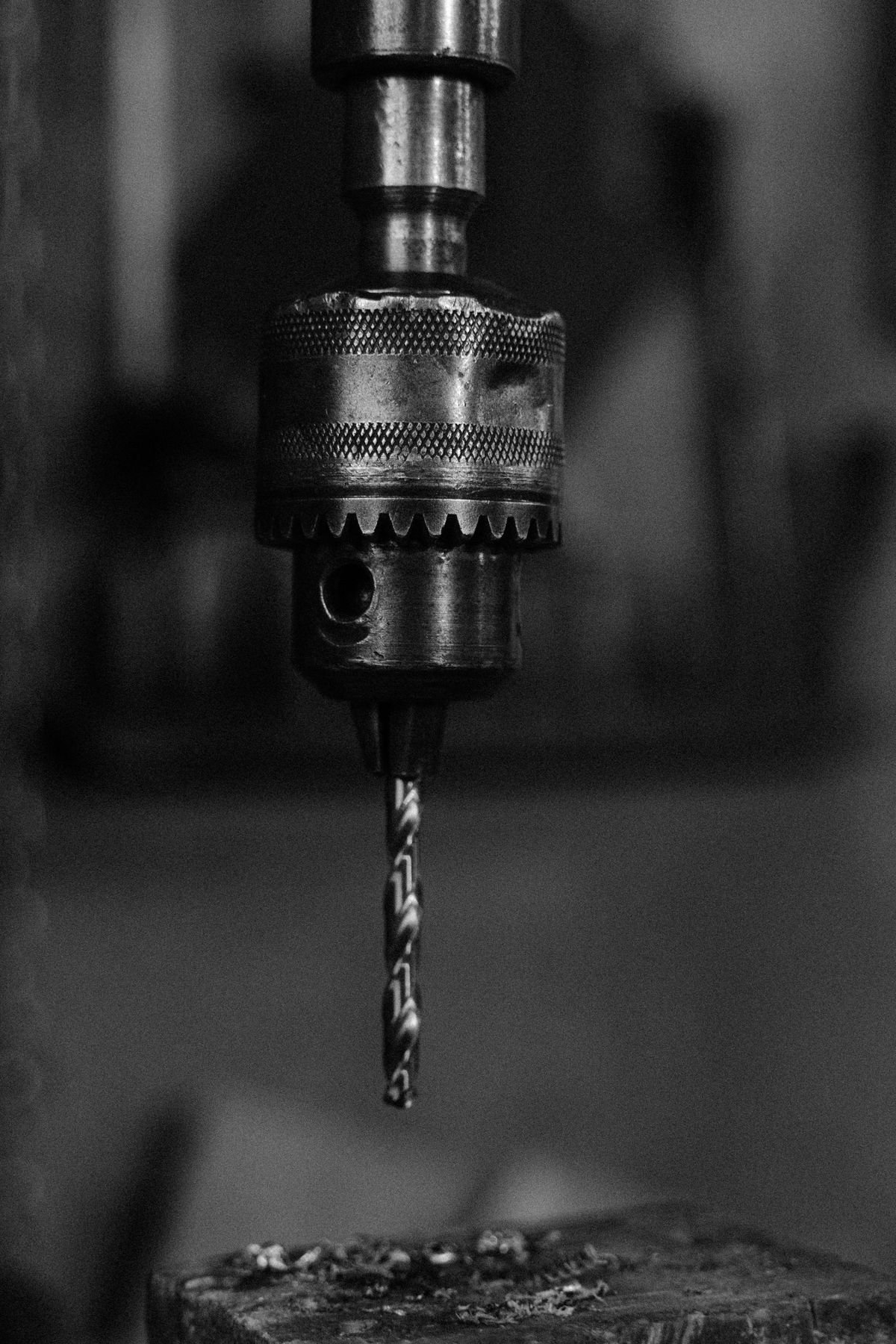
The shank is the part of the bit that the drill grips. It must match your drill’s chuck.
| Shank type | Fits | Notes |
|---|---|---|
| Round (straight) | Standard 3-jaw chucks | Most common; can slip under very high torque |
| Three-flat | 3-jaw chucks | Flats help the chuck grip and reduce slipping |
| Reduced shank | Smaller chucks | Lets large bits fit a 3/8″ or 1/2″ chuck |
| 1/4″ hex (quick-change) | Quick-change chucks and impact drivers | Fast bit changes; choose impact-rated bits for impact drivers |
| SDS-plus | SDS-plus rotary hammers | For concrete drilling and chiseling |
| SDS-max | SDS-max rotary hammers | Larger, heavy-duty concrete work |
| Morse taper | Drill presses, lathes and mills | Self-holding taper for large machine drills |
Drill Bit Materials and Coatings
| Material or coating | What it is | Best for |
|---|---|---|
| Carbon steel | Low-cost steel that softens with heat | Wood and soft materials; occasional use |
| High-speed steel (HSS) | Tool steel that holds hardness at higher temperatures | General drilling in wood, metal and plastic |
| Black oxide | A surface treatment on HSS that reduces friction and resists rust | Wood, plastic and mild steel |
| Titanium nitride (TiN) | A hard, gold-colored coating on HSS | Longer life in wood, plastic and softer metals |
| Cobalt (M35, M42) | HSS alloyed with cobalt throughout the bit | Stainless steel and hard metals |
| Carbide | Very hard tungsten carbide, solid or as a tip | Masonry, abrasive materials and hard metals |
| Diamond | Industrial diamond grit bonded to the bit | Porcelain, stone and glass |
A coating wears off with use and sharpening, while cobalt runs through the whole bit. That is why cobalt bits can be resharpened without losing their heat resistance, but titanium-coated bits lose some benefit once the coating is gone.
Drill Point Angles: 118° vs 135°
| Point angle | Characteristics | Best for |
|---|---|---|
| 118° | Sharper point; general-purpose; may wander on hard surfaces | Wood, plastic, soft metals |
| 135° split point | Flatter, self-centering tip that starts without a center punch | Harder metals and stainless steel |
Countersink Angles
| Angle | Used for |
|---|---|
| 82° | Inch flat-head screws (common in the U.S.) |
| 90° | Metric flat-head screws |
| 100° | Aircraft and some sheet-metal fasteners |
Match the countersink angle to your screws so the heads sit fully flush.
Recommended Speed by Bit Type
As a general rule, the larger the bit and the harder the material, the slower the speed. Follow the bit maker’s guidance when it is given.
| Bit type | Typical speed |
|---|---|
| Small twist and brad-point bits in wood | High |
| Twist bits in steel | Low to medium, with cutting oil |
| Cobalt bits in stainless steel | Low, with steady pressure and cutting oil |
| Spade bits | Medium to high |
| Forstner, auger and self-feed bits | Low |
| Hole saws | Low |
| Step bits in sheet metal | Low to medium |
| Masonry bits | Medium, in hammer mode |
| Tile, glass and diamond bits | Low, with water cooling and no hammer |
Drill Bit Lengths
- Jobber length: the standard length in most sets.
- Stubby (screw machine) length: shorter and stiffer; wanders less, good for metal and tight spaces.
- Taper length: longer for deeper holes.
- Extension and aircraft bits: extra-long bits for reaching through thick material; they flex more, so start the hole with a shorter bit.
How to Choose the Right Drill Bit
- Start with the material. Wood, metal, masonry and tile each need different cutting geometry.
- Decide on hole quality. Visible holes need brad-point or Forstner bits; hidden holes can use spade or self-feed bits.
- Check the size. Large holes need hole saws, Forstner or self-feed bits and a drill with enough torque.
- Match the shank to your tool. Round for chucks, hex for impact drivers, SDS for rotary hammers.
- Choose the material for the job. HSS for general use, cobalt for stainless steel, carbide for masonry.
- Buy quality where it matters. A few good bits in the sizes you use most beat a large set of soft bits.
Building a Practical Drill Bit Kit
| Level | What to include |
|---|---|
| Basic home kit | HSS or titanium twist set (1/16″ to 1/4″), a few masonry bits, a countersink |
| DIY woodworker | Add brad-point set, spade or self-feed bits, Forstner set, plug cutter |
| Metal work | Add cobalt set, step bit, cutting oil, center punch |
| Renovation | Add hole saw kit, SDS-plus bits, tile/glass bits, installer bit |
Common Drill Bit Mistakes
- Using wood bits on metal. Brad-point and spade bits are not designed for metal and will dull or break.
- Using hammer mode with tile or glass bits. Impacts crack brittle materials.
- Running large bits too fast. Speed creates heat; big bits and hard materials need low speed.
- Skipping lubrication in metal. Cutting oil reduces heat and extends bit life.
- Forcing a dull bit. Smoke, squealing and burn marks mean it is time to sharpen or replace the bit.
- Drilling without clamping. A spinning workpiece is dangerous; clamp it down.
How to Care for Drill Bits
- Store bits in a labeled case or index so the cutting edges do not knock together.
- Clean resin from wood bits and metal chips from metal bits after use.
- Keep bits dry to prevent rust, especially uncoated carbon-steel bits.
- Sharpen twist bits on a grinder or sharpening jig, keeping the original point angle; replace cheap or badly damaged bits.
Safety Tips
- Wear eye protection every time you drill.
- Clamp small parts and sheet metal; never hold them by hand.
- Check for hidden pipes and wires before drilling into walls.
- Wear a respirator when drilling masonry, which can release harmful dust.
- Unplug corded drills or remove the battery before changing bits.
Frequently Asked Questions
What are the most common types of drill bits?
The most common are twist bits, brad-point bits, spade bits, masonry bits, Forstner bits, hole saws and step bits.
What drill bit is best for wood?
Brad-point bits make the cleanest small and medium holes. Forstner bits are best for flat-bottom and larger clean holes, and spade or self-feed bits are fastest for rough holes.
What drill bit is best for metal?
HSS twist bits handle most metals. For stainless steel and hard metals, use cobalt bits with cutting oil. For thin sheet metal, a step bit gives clean holes.
What drill bit do I use for concrete?
Use a carbide-tipped masonry bit in a hammer drill, or an SDS-plus bit in a rotary hammer.
Can I use a wood bit on metal?
No. Wood bits are designed for wood fibers and will dull or break in metal.
Can I use a metal bit on wood?
Yes. Twist bits for metal drill wood well, though brad-point bits give cleaner holes.
What is the difference between cobalt and titanium bits?
Titanium bits are HSS with a hard surface coating. Cobalt bits are HSS alloyed with cobalt throughout, so they resist heat better and are preferred for stainless steel and hard metals.
What bit drills through tile?
Use a spear-point carbide tile bit for ceramic tile, or a diamond hole saw or core bit for porcelain, always with hammer mode off.
What is a step bit used for?
Step bits drill multiple hole sizes in thin metal and plastic and leave clean, deburred holes.
How do I know if a drill bit is dull?
A dull bit needs more pressure, squeals, smokes or burns wood, and leaves rough, oversized holes.
Summary
The right drill bit depends on the material and the hole you need. Keep a good set of twist bits for everyday work, add brad-point and Forstner bits for clean woodworking holes, spade or self-feed bits for fast holes through framing, cobalt and step bits for metal, and masonry or SDS bits for concrete. Match the shank to your tool, use the right speed, and your holes will be cleaner, faster and safer.