Hammer Drill vs Regular Drill: Key Differences and When You Need Each
A hammer drill and a regular drill look almost the same, and for most jobs they work the same way. The difference is one extra mode. A regular drill only spins the bit. A hammer drill can also tap the bit forward thousands of times a minute while it spins, which lets it break through brick, block and concrete.
Quick answer: if you only drill wood, metal, plastic and drywall and drive screws, a regular drill/driver is all you need. If you will ever drill into brick, block, stone or concrete, buy a hammer drill. With the hammer mode switched off, it works as a normal drill, so it can be your only drill.
Hammer Drill vs Regular Drill at a Glance
| Regular drill (drill/driver) | Hammer drill | |
|---|---|---|
| How it drills | Rotation only | Rotation, plus rapid forward blows in hammer mode |
| Best materials | Wood, metal, plastic, drywall | All of those, plus brick, block, stone and concrete |
| Screwdriving | Yes, with a clutch | Yes, with a clutch (hammer mode off) |
| Masonry | Slow and hard on bits; small holes in soft masonry at best | Designed for it, typically up to about 1/2 in with carbide bits |
| Modes | Drill and screwdriver | Drill, screwdriver and hammer |
| Size and weight | Often slightly smaller and lighter | Often slightly larger; on some twins the listed length is the same |
| Who should buy | Woodworkers, furniture assembly, general home repairs with no masonry | Anyone who will drill into masonry, or wants one drill for everything |
How Each Drill Works
Regular drill (drill/driver)
A regular cordless drill, usually called a drill/driver, spins the chuck. It has a clutch with numbered settings, so it can slip at a set torque when you drive screws, and a drill setting with the clutch locked for drilling holes. It is the right tool for wood, metal, plastic and drywall.
Hammer drill
A hammer drill does everything a drill/driver does, then adds a hammer mode. Inside the gearbox, two ridged discs ride over each other as the chuck turns, pushing the bit forward and back in tiny, rapid blows. The carbide tip of a masonry bit chips the material while the flutes carry the dust out. On DEWALT’s 20V MAX DCD998, for example, the manual lists up to 38,250 blows per minute in the top gear.
Because the blows come from the rotation, the hammer rate rises and falls with the motor speed. That is also why a hammer drill is lighter-duty than a rotary hammer, which uses a piston to deliver much heavier blows.
Same Drill, Two Versions: What Actually Changes
Most brands sell a drill/driver and a hammer drill that are built on the same platform. Comparing these “twins” shows what the hammer mode really adds. Here is DEWALT’s 20V MAX XR pair, using the capacity table from the official manual:
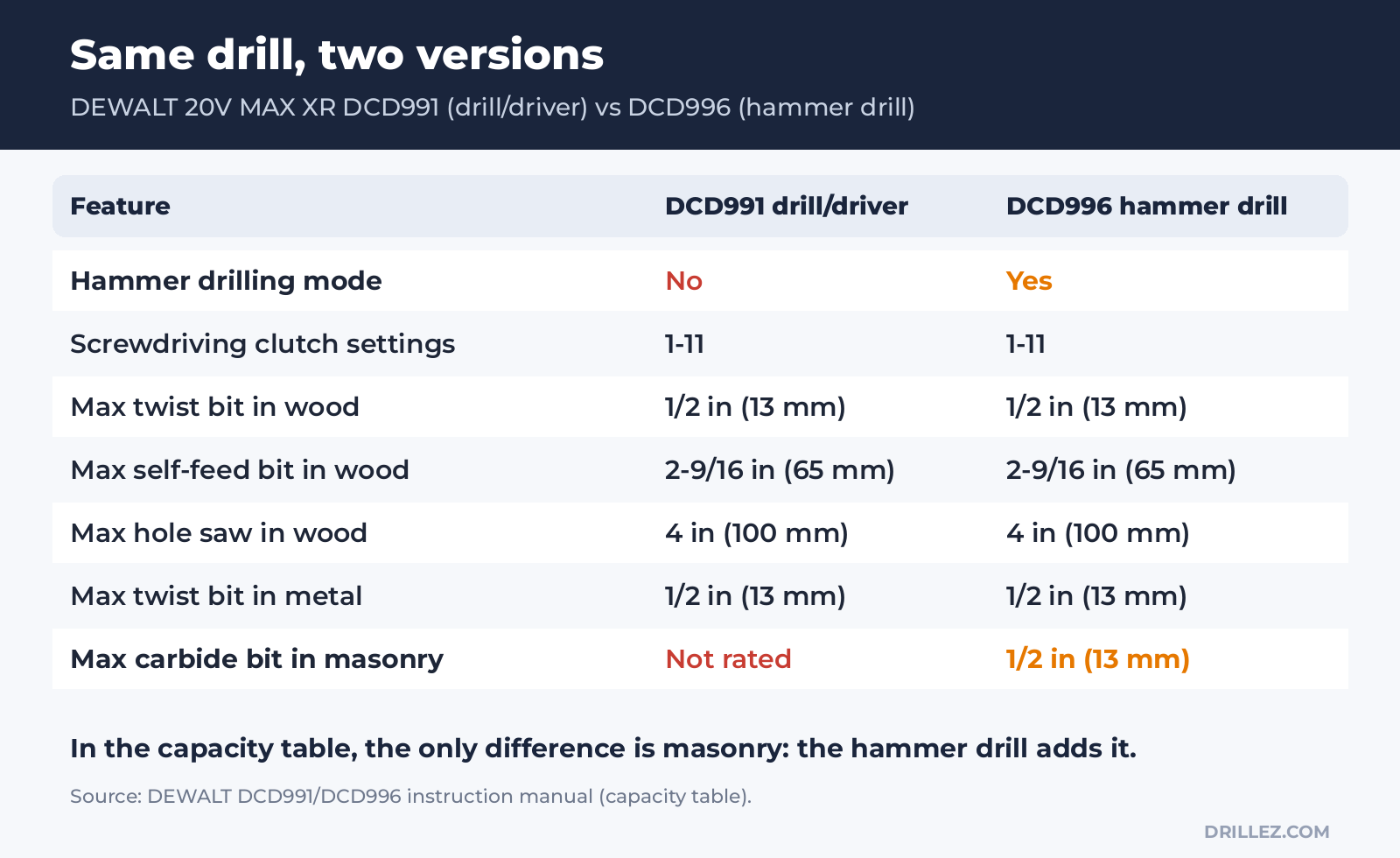
The two tools have the same clutch range and the same rated capacity in wood and metal. The only difference in the table is masonry: the DCD996 hammer drill is rated for carbide bits up to 1/2 in, and the DCD991 drill/driver is not rated for masonry at all.
Milwaukee’s M18 FUEL pair is similar. Milwaukee lists both the 2903-20 drill/driver and the 2904-20 hammer drill/driver at 1,400 in-lbs of maximum torque and 6.9 in long. In other words, on modern brushless tools the hammer drill usually gives up very little to gain its masonry ability.
How to Tell Them Apart
If you are not sure which drill you own, look at the collar behind the chuck:
- Hammer drill: the collar has a hammer symbol next to the drill-bit symbol and the numbered clutch settings. The tool name often includes “hammer drill” or “hammerdrill”.
- Regular drill/driver: the collar has only a drill-bit symbol and numbered clutch settings.
- Not to be confused with: an impact driver, which has a 1/4 in hex collet instead of a chuck and no clutch, or a rotary hammer, which takes SDS bits.
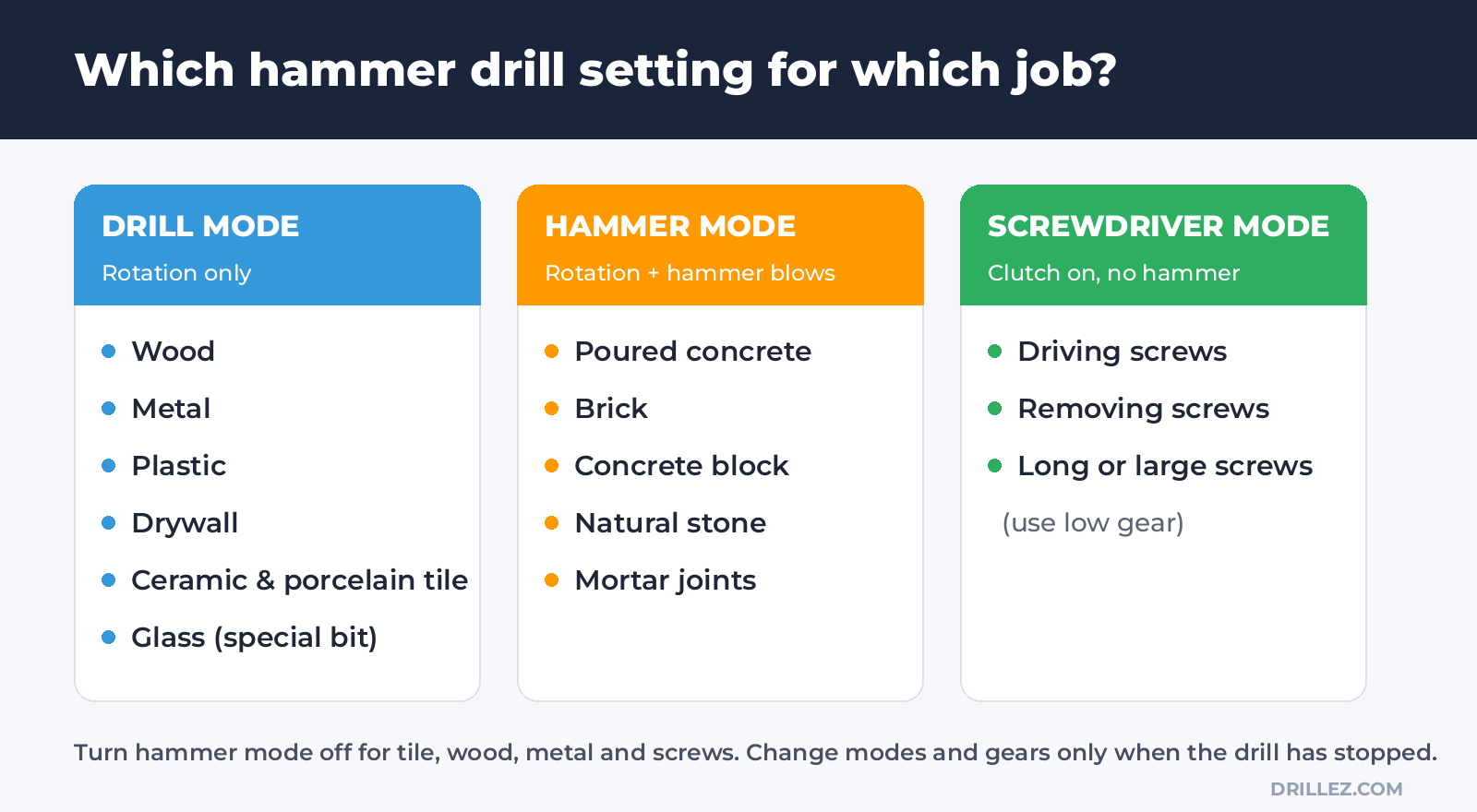
When to Use Each
| Job | Regular drill | Hammer drill |
|---|---|---|
| Drilling wood | Yes | Yes (hammer off) |
| Drilling metal | Yes | Yes (hammer off) |
| Driving screws | Yes | Yes (clutch setting) |
| Drywall | Yes | Yes (hammer off) |
| Ceramic or porcelain tile | Yes, with a tile or diamond bit | Yes, but hammer off |
| Brick and mortar | Slow; small holes only | Yes (hammer on) |
| Concrete block | Slow | Yes (hammer on) |
| Poured concrete | Very slow, wears bits fast | Yes, up to about 1/2 in |
| Large or many holes in concrete | No | Consider a rotary hammer |
For step-by-step technique, see our guides on how to use a hammer drill and how to drill into a concrete wall.
Can a Regular Drill Go Through Concrete?
Sometimes, slowly. With a sharp carbide masonry bit, a regular drill can make a few small holes in soft brick or mortar. In poured concrete, it mostly grinds: the hole takes a long time, the bit gets very hot, and the tip wears out. If you have more than a couple of holes to make in masonry, a hammer drill saves time and bits. For jobs beyond about 1/2 in, or lots of holes in hard concrete, a rotary hammer is the better tool.
Pros and Cons
Regular drill
- Pros: often a little smaller and lighter; simple controls; ideal for wood, metal and screws.
- Cons: not designed for masonry; you will need another tool if a concrete or brick job comes up.
Hammer drill
- Pros: handles masonry as well as everything a drill/driver does; one tool for most home jobs.
- Cons: often a little larger; loud in hammer mode; still not a substitute for a rotary hammer on big concrete jobs.
Which One Should You Buy?
- Buy a regular drill/driver if your work is woodworking, furniture, cabinets or general repairs and you are sure you will not drill into masonry. A compact model is easier to handle all day.
- Buy a hammer drill if you own a home with brick, block or concrete walls, a garage or basement, or you simply want one drill that can do everything. Within the same brand line the price difference is often small, so check current prices for the specific models you are considering.
- Add a rotary hammer later if you start drilling many holes, holes larger than about 1/2 in, or very hard concrete.
- Pair it with an impact driver if you drive lots of long screws; it is the best partner to either drill.
If you have decided on a hammer drill, our roundup of the best hammer drills for concrete compares cordless and corded models. If you prefer a plug-in drill for workshop use, see the best corded drills.
Common Mistakes
- Leaving hammer mode on for wood or metal. It adds nothing and can make the bit wander or split the wood.
- Using hammer mode on tile. Drill through tile in drill mode with a tile or diamond bit, then switch to hammer for the masonry behind.
- Driving screws in hammer mode. Use the numbered clutch settings instead so you do not strip the screw or the hole.
- Using ordinary bits in masonry. Only carbide-tipped masonry bits belong in hammer mode.
- Expecting a regular drill to do concrete work. It will struggle; a hammer drill or rotary hammer is the right tool.
Frequently Asked Questions
Can I use a hammer drill as a regular drill?
Yes. Turn the collar to the drill setting (or a clutch number for screws) and the hammer action stops. It then works like a normal drill/driver for wood, metal and screws.
Can I use regular drill bits in a hammer drill?
Yes, in drill mode. In hammer mode, use carbide-tipped masonry bits rated for percussion; DEWALT’s manuals specify this. Twist, brad-point and spade bits are not made for hammering. See our guide to types of drill bits.
Is a hammer drill more powerful than a regular drill?
Not necessarily. On matched pairs, such as Milwaukee’s M18 FUEL 2903-20 and 2904-20, the listed maximum torque is the same. The hammer drill is not stronger in rotation; it simply adds hammer blows for masonry.
Does hammer mode wear the drill out faster?
Hammer mode adds mechanical work, so it makes sense to use it only when you are drilling masonry and to switch it off for everything else. We have not found published wear data from manufacturers comparing the two modes.
Is a hammer drill the same as an impact driver?
No. A hammer drill hammers forward along the bit for masonry. An impact driver hammers around the bit to drive long screws and bolts. Read our hammer drill vs impact driver guide for details.
Do I need a hammer drill to drill into brick?
For one or two small holes in soft brick or mortar, a regular drill with a masonry bit can work. For anything more, a hammer drill is much faster and easier on bits.
Summary
A regular drill spins; a hammer drill spins and can also hammer. If you never drill masonry, a drill/driver is enough. If brick, block or concrete are ever on the list, a hammer drill does everything a regular drill does, plus masonry, and on matched pairs it gives up very little in size or torque to do it.